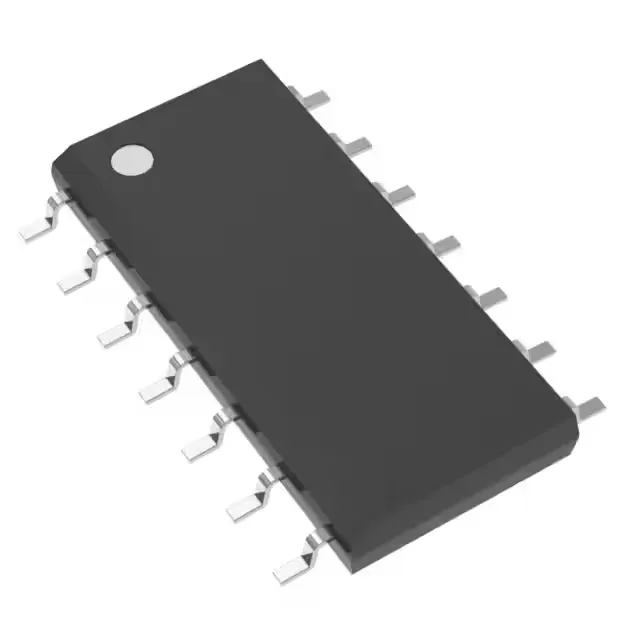
Texas Instruments TLV2254IDR — Analog & Data Acquisition

Texas Instruments TLV2254IDR LinCMOS Quad Op-Amp, 200 kHz

MPNTLV2254IDR
End of Life

Texas Instruments TLV2254IDR, LinCMOS™ series, quad general-purpose op-amp, 200 kHz gain bandwidth, 0.12 V/µs slew rate, rail-to-rail output, 2.7 V to 8 V supply, 140 µA supply current, 14-SOIC package, -40°C to 125°C.

$3.2Ref. price · indicative, final on quote
Packaging14-SOIC (0.154", 3.90mm Width)
RoHSROHS3 Compliant
SeriesLinCMOS™
Independent supplier — new & surplus stockAuthenticity-screened · ESD-safe packingListing updated Aug 2026

Specifications

TLV2254IDR specifications
ParameterValue
SeriesLinCMOS™
Output typeRail-to-Rail
MountingSurface Mount
Amplifier typeGeneral Purpose
Voltage - input offset200 µV
Voltage - supply span2.7 V
Current - supply140µA (x4 Channels)
Current - input bias1 pA
Current - output (Channel)50 mA
Operating temperature-40°C ~ 125°C
Gain bandwidth product200 kHz
PackageTape & Reel (TR); Cut Tape (CT)
Slew rate0.12V/µs
Case14-SOIC (0.154\", 3.90mm Width)
Number of circuits4

Product details

Quad micropower op-amp for industrial and battery-powered signal chains

At 200 kHz gain-bandwidth, this op-amp is intended for low-frequency filtering, buffering, and precision DC amplification — not for video or high-speed data acquisition. The 1 pA typical input bias current suits high-impedance sources such as photodiode transimpedance stages or pH probe buffers, where a bipolar-input part would add unacceptable offset drift. The 200 µV input offset voltage is adequate for 12-bit systems with gain up to 100; for higher resolution, a zero-drift amplifier would be needed. The 140 µA total supply current includes all four amplifiers — about 35 µA per channel — which keeps self-heating negligible in the 14-SOIC package even at elevated ambient temperatures.

Lifecycle and sourcing — active with no near-term EOL signal

Buyers should verify date-code consistency and marking font against TI's factory etch standards when accepting broker stock — the laser etch on the 14-SOIC body should match TI's known plant-specific character set for the week code.

Package and footprint — 14-SOIC with standard pitch

The surface-mount package is compatible with reflow soldering;.

Frequently asked questions

Is TLV2254IDR obsolete?

No. It remains available through the independent distribution channel and can be quoted to order.

Is TLV2254IDR rail-to-rail output?

Yes, the TLV2254IDR features rail-to-rail output, meaning the output voltage can swing within millivolts of both supply rails. The input common-mode range is not rail-to-rail, so verify it covers the signal range for your application.

What is the difference between TLV2254IDR and TLV2254ID?

The TLV2254IDR suffix indicates Tape & Reel packaging, while the TLV2254ID variant typically ships in tubes or other packaging. The die, performance specs, and temperature grade are identical. For production reels, the 'R' suffix is the standard ordering code.

Can TLV2254IDR be used as a comparator?

While a general-purpose op-amp can be pressed into comparator service, the TLV2254IDR is not designed for open-loop comparator use. Its 0.12 V/µs slew rate leads to slow propagation delay, and the lack of internal hysteresis means output chatter near the threshold. A dedicated comparator such as the TLV3011 is a better fit for that role.

What is the equivalent of TLV2254IDR?

The TLV9351IDCKR is a single-channel CMOS op-amp with 3.5 MHz GBP and 20 V/µs slew rate — a faster, higher-bandwidth part but not a direct pin-compatible replacement for the quad TLV2254IDR. For a quad replacement, the OPA4374AIPWT offers 6.5 MHz GBP and 5 V/µs slew rate in the same 14-SOIC footprint, though it draws more supply current (600 µA typical per quad). Neither is a drop-in substitute; verify the supply range and bandwidth requirements against your design.