Active production, no last-time-buy pressure
The TLV07IDR: ROHS3 compliant — no exemption conflicts for EU or California market shipments.
50 µV offset, 1 MHz GBW — precision for sensor conditioning
Input offset voltage is 50 µV typical — this is the DC error the signal chain sees before any gain. For a gain-of-100 stage, the output offset contribution is 5 mV, which is low enough to avoid clipping in a 0-5 V ADC front-end without a nulling trim. Gain bandwidth product is 1 MHz with a slew rate of 0.4 V/µs. At a closed-loop gain of 10, the small-signal bandwidth is roughly 100 kHz — sufficient for thermocouple, RTD, or strain-gauge conditioning loops where the signal bandwidth is below 10 kHz. Rail-to-rail output means the op-amp swings within millivolts of the supply rails — useful when running from a single 3.3 V or 5 V rail and the ADC reference is the same supply.
2.7 V to 36 V supply — single-rail flexibility
Supply span runs from 2.7 V minimum to 36 V maximum. This covers 3.3 V and 5 V logic rails as well as industrial 24 V systems — no dual-rail supply needed. Quiescent current is 930 µA typical — low enough for battery-powered field transmitters that run on a 24 V loop-powered 4-20 mA interface. Input bias current is 40 pA typical, so a 10 kΩ source resistor contributes only 0.4 µV of offset — negligible for most precision loops. Operating temperature range is -40°C to 125°C — this is the industrial/automotive ambient band. A sensor module mounted on a motor housing or in an engine bay sees 105°C on a hot day and still has margin.
8-SOIC — standard footprint, wide second-source availability
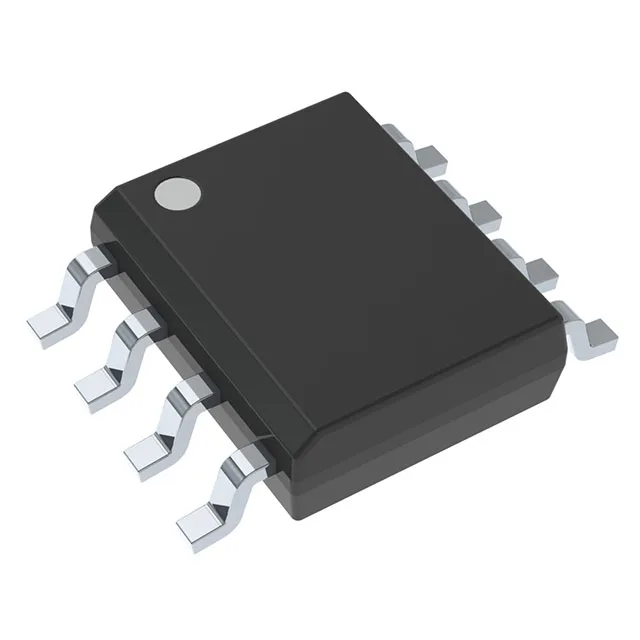
Package is 8-SOIC (0.154", 3.90 mm width) — a JEDEC-standard footprint shared by dozens of op-amp vendors. The same PCB land pattern accepts pin-compatible parts from Analog Devices, Microchip, and others, so the BOM can be dual-sourced without a board spin. Supplied in Tape & Reel or Cut Tape — pick-and-place ready for volume assembly, or cut-tape for prototype runs.