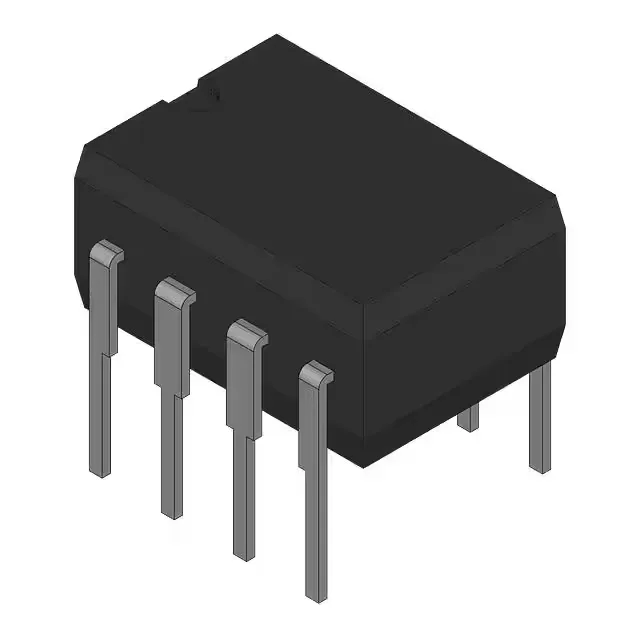
What this JFET op-amp does in a high-reliability signal chain
The TLE2061AMJGB: It combines a 2 MHz gain-bandwidth product with a 3.4 V/µs slew rate, drawing only 290 µA of supply current. The JFET front end keeps input bias current at 4 pA, making it the natural choice for precision analog interfaces where the source impedance is high — photodiode amplifiers, pH probe buffers, piezoelectric sensor conditioners, and electrometer-grade transimpedance stages.
Hermetic CDIP — why the package matters for mission-critical boards
The ceramic 8-CDIP package blocks moisture ingress and outgassing. Through-hole mounting inserts into plated through-holes for wave or hand soldering.
Slew rate and bandwidth — what 3.4 V/µs and 2 MHz mean for your signal
For a 2 V peak-to-peak sine wave, that supports frequencies up to roughly 270 kHz before slew-rate limiting distorts the waveform. The 2 MHz gain-bandwidth product sets the small-signal bandwidth: at a closed-loop gain of 10, the -3 dB point lands at 200 kHz. These figures place the TLE2061AMJGB in the general-purpose precision band — fast enough for audio, servo loops, and data-acquisition front ends, but not intended for video or high-speed ADC drivers where 100+ V/µs parts are needed. The 80 mA output current per channel gives it enough drive to swing into a 600 Ω load or a modest cable capacitance.