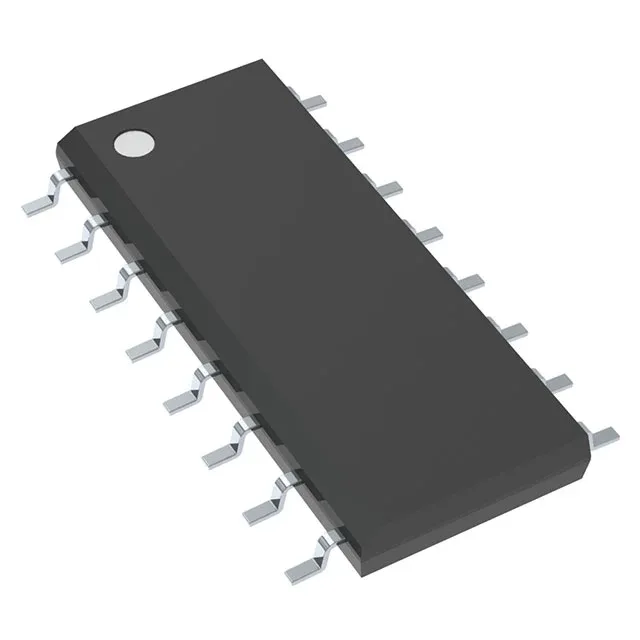
8-bit multiplying DAC with R-2R ladder
The TLC7524ED is an 8-bit multiplying digital-to-analog converter built around a precision R-2R ladder network. It accepts an 8-bit parallel word and outputs a differential current proportional to the product of the digital code and the external reference voltage. Settling time is 100 ns to within ±½ LSB, which gives a theoretical update rate of 10 MSPS — though real throughput depends on the external op-amp's slew rate and the parallel bus timing from the host controller. The differential current outputs (I_OUT and I_OUT_BAR) let you drive a differential transimpedance amplifier, rejecting common-mode noise picked up on the analog traces between the DAC and the amplifier.
Supply rails and reference drive
The TLC7524ED needs two supply rails: a 5 V digital supply for the logic interface, and a 14.5 V to 15.5 V analog supply that biases the R-2R ladder and sets the output current swing. The external reference voltage (VREF) applied to the reference input sets the full-scale output current. Because the reference input is high-impedance, the reference source must be able to drive the R-2R ladder's varying input resistance — a precision reference with a low output impedance is recommended, not a simple resistor divider. Operating temperature range is -40°C to 85°C, covering industrial control cabinets, test equipment, and outdoor telecom shelters — but not under-hood automotive or downhole environments.
Linearity limits and monotonicity risk
The integral nonlinearity (INL) is ±0.5 LSB maximum, which is tight for an 8-bit part — the output stays within half a step of the ideal transfer function across the full code range. The differential nonlinearity (DNL) is ±2.5 LSB maximum, meaning some adjacent code transitions can be missing or have steps larger than 1 LSB. The DAC is not guaranteed monotonic — a rising digital code may produce a non-increasing analog output at some codes. On the repair bench, if a board using this DAC shows glitches or non-monotonic behavior at specific codes, the DNL spec is the first suspect — not a failed part, but a design limitation of the R-2R architecture at this price point.
Package and board-fit
The TLC7524ED comes in a 16-pin SOIC package (16-SOIC, 0.154-inch body width, 3.90 mm, 1.27 mm pitch). The SOIC-16 footprint is standard — no exposed pad, no thermal vias required. The part is surface-mount and reworkable with standard hot-air tools. The 1.27 mm pitch gives good clearance for manual probing during debug.
The part is ROHS3 compliant (no exemptions), which avoids the REACH and RoHS exemption tracking burden for EU and California markets.