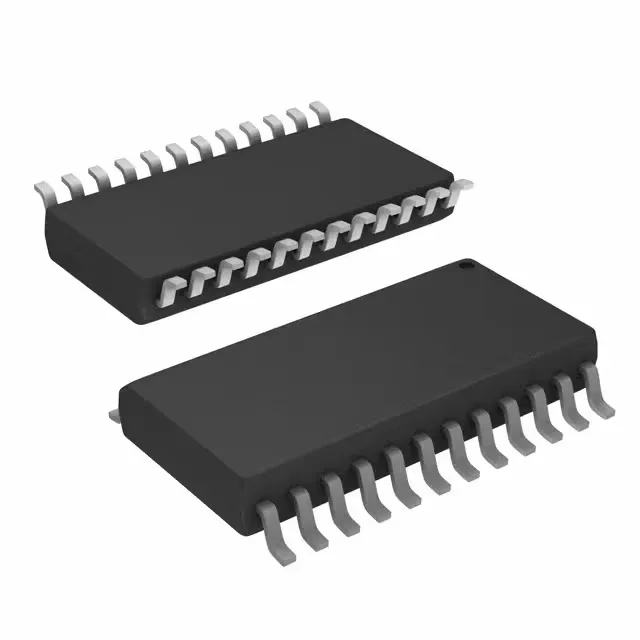
Active — no end-of-life signals on this quad 8-bit DAC
The TLC7225IDW: It is a quad 8-bit voltage-output DAC using an R-2R ladder architecture, settling to within 1 LSB in 7 µs typical. Four independent converters in one 24-SOIC package suit multi-channel analog output applications where per-channel cost and board area matter.
7 µs settling, ±1 LSB INL — what the numbers mean for your loop
The 7 µs settling time (to ±1/2 LSB) sets the update rate ceiling: at 8 bits, each conversion step is about 27 µs including the write cycle, so the DAC can be updated at roughly 37 kHz without missing the settling window. For a slow-control loop (valve position, setpoint trim), that is generous; for a waveform generator, it limits the output to sub-20 kHz sine waves. INL and DNL are both specified at ±1 LSB maximum over temperature. That guarantees monotonicity and no missing codes across the full 256-step range — critical when the DAC drives an actuator that must not skip a step on power-up or during a temperature sweep. The analog supply rails are 11.4 V to 16.5 V on the positive side and a separate -5.5 V rail for the negative supply. This split-rail requirement means the board must carry a -5.5 V supply — not a given in a single-supply system — but it allows the output to swing near ground without a negative charge pump. Operating temperature range is -25°C to 85°C, which covers most industrial and commercial enclosures but not extended automotive or under-hood environments. For a panel-mounted controller or test equipment that stays indoors, it is well within the margin.
24-SOIC wide-body — footprint and compliance
The 0.295-inch (7.50 mm) width matches the SOIC-W (wide) land pattern — no special stencil or reflow profile needed beyond the standard JEDEC MS-013. ROHS3 compliant — no exemptions that would require a waiver for EU or UKCA markets. The part is also free of the six original RoHS substances plus the four phthalates added in RoHS3.
For a BOM that already uses this DAC, the supply risk is low. For a new design, the quad 8-bit resolution and parallel interface are mature but still widely supported; if a higher resolution or serial interface is preferred, a pin-compatible alternative does not exist in the same package, so a board spin would be required.