Backlight LED driver with shift register interface
The TLC5943RHBT is a 16-channel linear LED driver from Texas Instruments, built around a shift register topology that accepts a 30 MHz serial clock. Each of the 16 outputs sinks up to 50 mA, with a total output voltage compliance of 17 V — enough headroom for multiple LEDs in series per string in backlight applications.
What the 50 mA per channel means for your string design
At 50 mA per channel, this part is sized for medium-brightness LED backlight strings — think 6 to 10 LEDs in series per channel at typical forward voltages. The 17 V output ceiling means you can stack about four white LEDs (3.2 Vf each) before hitting the compliance limit; for higher-voltage strings you need an external boost stage ahead of the driver. The shift register interface lets you daisy-chain multiple TLC5943 devices on a single serial bus, updating all channels at the 30 MHz clock rate. At 16 bits per device, a 30 MHz clock updates one full frame in roughly 0.5 µs per device — fast enough for PWM dimming rates well above the visible flicker threshold.
Package and board-fit considerations
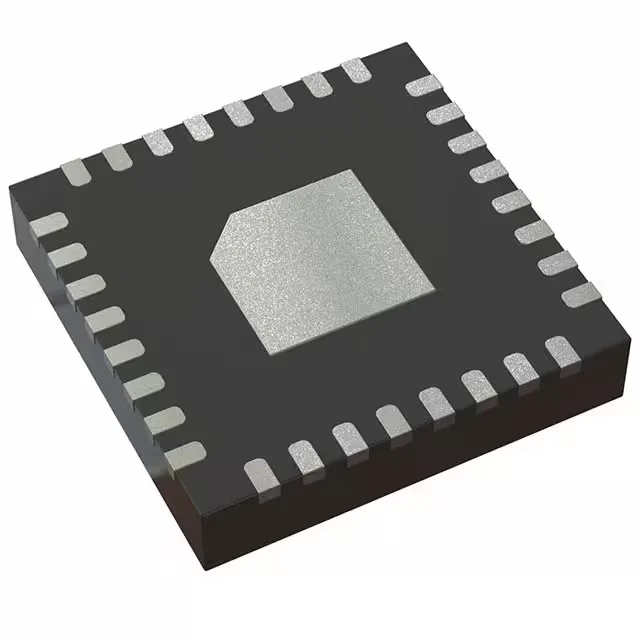
Supplied in a 32-VFQFN with exposed pad (5x5 mm body). The thermal pad on the underside must be soldered to a PCB copper plane for heat spreading — at 50 mA × 16 channels the total dissipation hits about 1.5 W at full drive, and the exposed pad is the primary thermal path. The 0.5 mm pitch QFN demands careful solder paste stencil design; a four-layer board with thermal vias under the pad is recommended for continuous full-load operation.