Active 16-channel constant-current sink for signage arrays
The TLC5929RGER is a linear LED driver from Texas Instruments, built around a shift register topology and designed to sink constant current across 16 outputs at up to 50 mA per channel. It targets signage applications where multiple LEDs must be driven with uniform brightness from a single data stream.
What the 20 MHz clock and 50 mA per channel mean for your layout
The 20 MHz serial data clock sets the update rate for the shift register chain. At 20 MHz, a full 16-channel frame loads in 800 ns, so you can refresh a string of daisy-chained drivers at several hundred hertz without visible flicker — useful for large-format signage panels with hundreds of LEDs. Each output sinks up to 50 mA with a maximum output voltage compliance of 10 V.
Shift register topology — daisy-chaining without extra GPIO
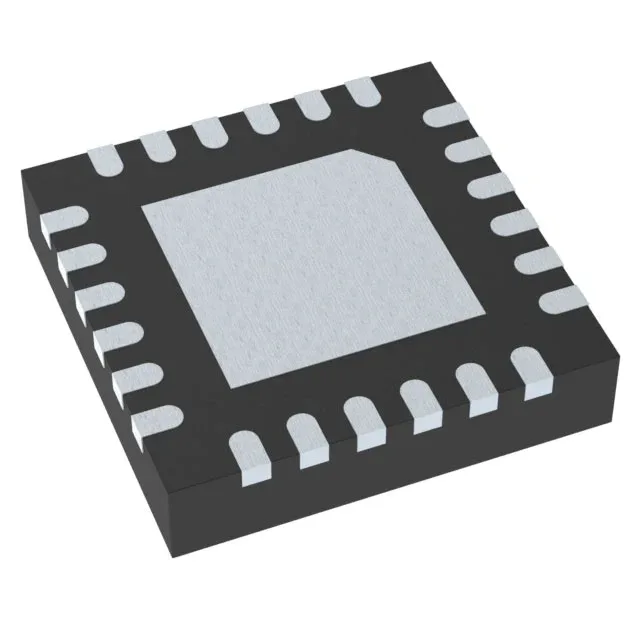
Because the driver uses a shift register interface, multiple TLC5929RGERs can be chained on a single SPI-like bus: data out of one feeds data in to the next. The controller updates all channels with one burst of clock pulses, then latches them simultaneously. This keeps the microcontroller pin count low — three signals (data, clock, latch) drive any number of drivers. The 24-VQFN package measures 4x4 mm with an exposed thermal pad. For best thermal performance, the PCB layout should connect the pad to a ground plane with multiple vias — the datasheet's recommended footprint is the starting point.