ROHS3 compliant, which covers current EU and most global assembly lines without exemption paperwork.
Quad comparator with CMOS open-drain outputs
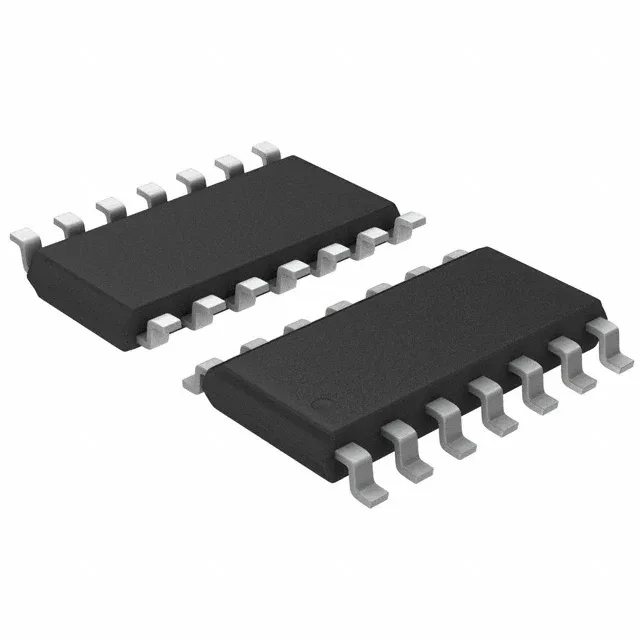
Four independent comparators in a single 14-SOIC package, each with a CMOS open-drain output stage. The open-drain lets you wire-OR multiple outputs or pull to a different rail than the supply — useful for level-shifting or driving a logic input at 3.3 V while the comparator runs from 5 V or 12 V.
84 dB CMRR and 5 pA input bias — signal-chain fit
Typical CMRR of 84 dB keeps the threshold accurate when the common-mode voltage shifts — relevant for sensor thresholding or zero-crossing detection in noisy environments. Maximum input bias current of 5 pA at 5 V means the comparator does not load high-impedance sources like pH probes or photodiode amplifiers.
4.5 µs propagation delay — speed ceiling for switching
Maximum propagation delay of 4.5 µs sets the upper frequency for clean output transitions. Below roughly 110 kHz you get full-swing edges; above that the output may not reach the rail before the next transition. For faster loops, consider the TLC372MDR differential comparator.
100 µA quiescent current — low-power bias
Maximum quiescent current of 100 µA across all four comparators — about 25 µA per channel.
3 V to 16 V supply — single or dual rails
Supply range from 3 V to 16 V covers single-supply designs (3.3 V, 5 V, 12 V) and dual-supply configurations (±1.5 V to ±8 V).
This is a commercial-grade part — fine for office equipment, appliances, and indoor industrial control panels. Not rated for automotive or extended industrial environments; for those, look at the TLC372MDR which covers -55°C to 125°C.