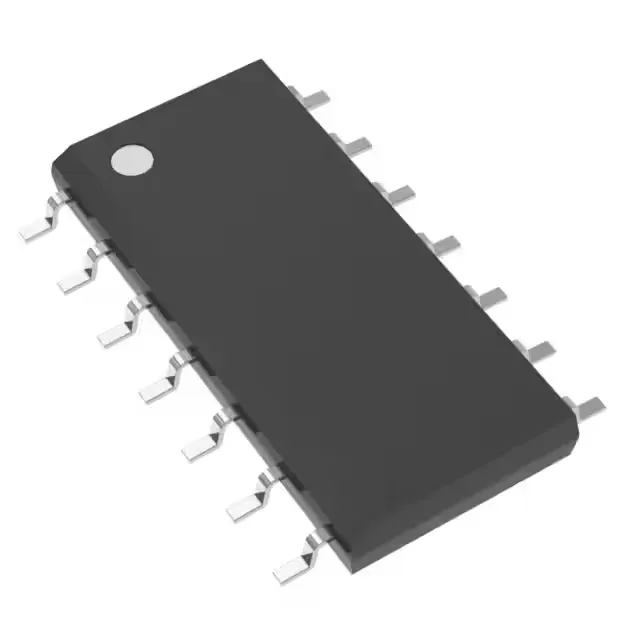
Quad low-power CMOS op-amp for multi-channel signal chains
It draws a total supply current of 570 µA across all four channels, making it a strong fit for battery-powered or thermally constrained multi-stage analog front-ends.
Input bias and offset — what they mean for sensor interfaces
With an input bias current of 0.7 pA, the TLC27M9ID can interface directly with high-impedance sources like photodiodes, pH electrodes, and piezoelectric sensors without the offset errors that bipolar-input op-amps introduce. The 220 µV input offset voltage keeps DC accuracy tight enough for most precision loops and instrumentation amplifiers — you won't need external trim for typical gains up to 100. These two specs together let the designer skip the extra buffer stage that a higher-bias op-amp would demand.
The TLC27M9ID operates from a 4 V to 16 V supply span, covering single-supply 5 V and 12 V rails as well as split ±2.5 V to ±8 V supplies.
ROHS3 compliant per the listing, so no conflict with current environmental directives.
This is a standard catalog part available through independent distribution — no last-time-buy clock ticking.