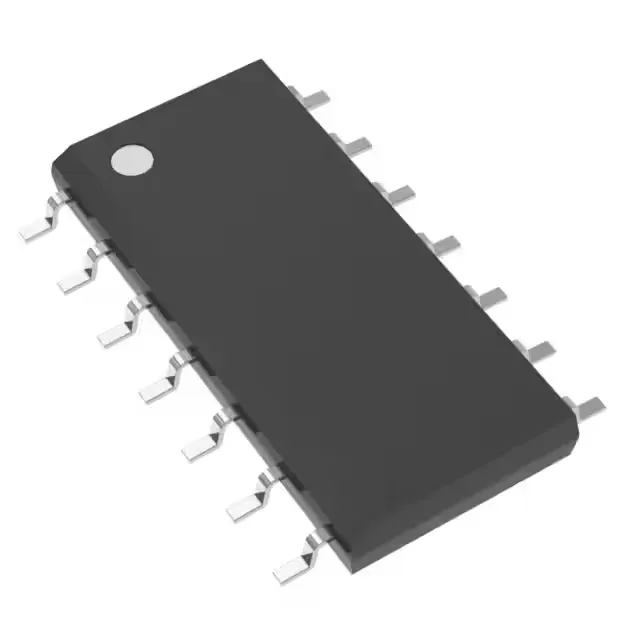
The TLC274IDR is a quad-channel general-purpose op-amp with a gain-bandwidth product of 2.2 MHz and a slew rate of 3.6 V/µs. This combination supports signal conditioning in the 100–200 kHz range at moderate gains, typical for sensor buffers, active filters, and ADC front-ends. Supply current is 2.7 mA for all four amplifiers, which keeps the total quiescent draw under 3 mA — a practical advantage in multi-channel boards where per-channel power budgets are tight.
Supply range and output drive capability
Supply span runs from 4 V minimum to 16 V maximum, so the part works on single 5 V or 12 V rails and dual ±2.5 V to ±8 V supplies — no separate negative rail needed for many single-supply designs. Each output can source or sink 30 mA, enough to drive a 2 kΩ load to within 1.5 V of the rails, or to feed a 10-bit ADC input directly. Input bias current is 0.6 pA typical, which minimises offset errors from source impedance — useful when the front-end is a high-impedance sensor like a pH probe or photodiode.
Texas Instruments lists no direct successor; the TLC274 family continues as a current catalog item.
SOIC-14 footprint and tape-and-reel delivery
Housed in a 14-SOIC package with 0.154-inch body width and 1.27 mm pin pitch. The surface-mount footprint is common across many quad op-amp families, easing layout reuse. The TR format suits automated pick-and-place for volume production; CT works for prototypes or low-volume builds.