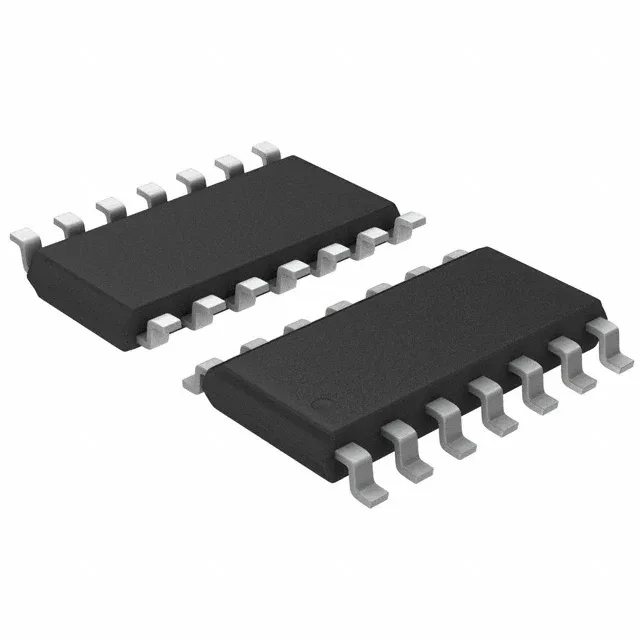
Quad op-amp for multi-stage signal chains
Each channel can source or sink 30 mA, and the supply range spans 3 V to 16 V, covering common 5 V and 12 V rails.
The 2.2 MHz gain-bandwidth product sets the usable closed-loop gain × bandwidth limit: a gain-of-10 stage stays flat to about 220 kHz, enough for audio processing, sensor filtering, or ADC anti-aliasing. The 3.6 V/µs slew rate supports full-power output swings up to roughly 115 kHz at 5 V peak-to-peak — adequate for general-purpose analog but not for fast pulse or video signals.
0.6 pA input bias — why it matters for sensor interfaces
The CMOS input stage draws only 0.6 pA of bias current, which means negligible voltage drop across high source impedances. A 10 MΩ source resistor creates just 6 µV of offset error — invisible in most circuits. This makes the TLC274CNSR a natural fit for photodiode amplifiers, pH probes, or any application where the signal source cannot tolerate loading.
Supply range: 3 V to 16 V — single or dual rails
The 3 V minimum supply lets the TLC274CNSR run from a single lithium cell or a 3.3 V rail, while the 16 V maximum accommodates 12 V industrial supplies. Total quiescent current for all four amplifiers is 2.7 mA (about 675 µA per channel), keeping the power budget modest in multi-channel designs.