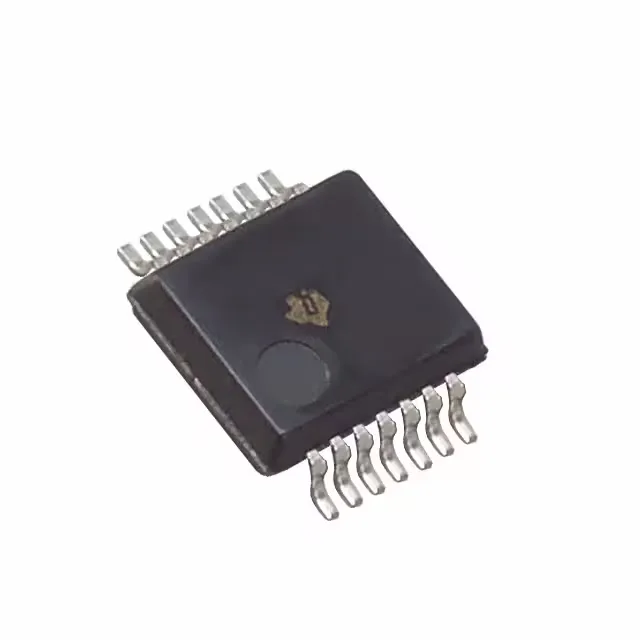
Quad op-amp for multi-channel signal conditioning
The 0.6 pA input bias current suits high-impedance sources like photodiodes or pH probes without needing a separate buffer stage.
The 2.2 MHz gain-bandwidth product sets the usable closed-loop gain vs frequency trade-off. At a gain of 10, expect a -3 dB bandwidth around 220 kHz; at unity gain, the full 2.2 MHz is available. The 3.6 V/µs slew rate limits large-signal response — a 5 V peak-to-peak output swing slews in about 1.4 µs, which keeps distortion low for audio up to a few tens of kHz. For designs needing faster settling (e.g., 100 kHz+ PWM loops), the OPA4374AIPWT (5 V/µs) offers a higher slew rate at the cost of a smaller output current rating.
Active lifecycle, ROHS3 — no end-of-life pressure
The 14-SSOP package is a current-production footprint shared across TI's LinCMOS family, so supply continuity looks solid for production programs.
Supply rails and thermal — 3 V to 16 V, commercial temp grade
Operating from 3 V (minimum) to 16 V (maximum), the TLC274CDBR covers single-supply designs (3.3 V, 5 V, 12 V) and split supplies (±2.5 V to ±8 V). For automotive or outdoor industrial use, the OPA4374AIPWT or TLV9351IDCKR with -40°C to 125°C rating would be the appropriate choice.