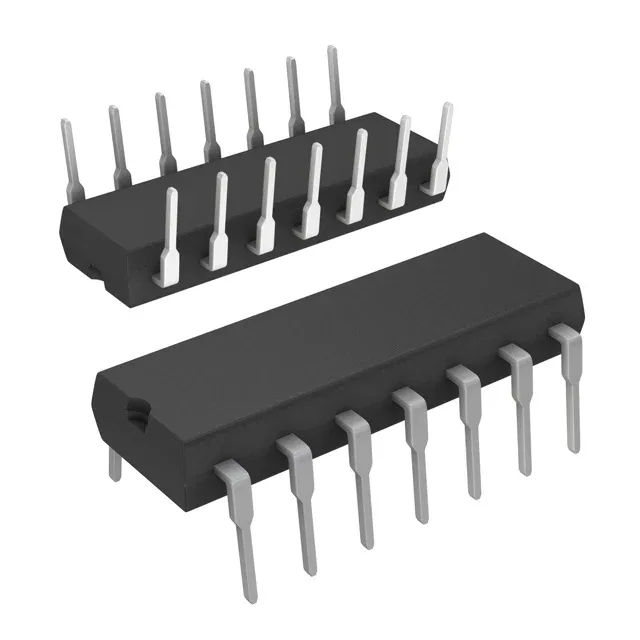
Texas Instruments TLC2264CN — Logic ICs

TLC2264CN LinCMOS quad op-amp, 730 kHz GBW, DIP-14

MPNTLC2264CN
End of Life

Texas Instruments LinCMOS™ TLC2264CN, quad general-purpose op-amp, 730 kHz gain bandwidth, 0.55 V/µs slew rate, rail-to-rail output, 850 µA supply per channel, 14-DIP through-hole package.

$3.06Ref. price · indicative, final on quote
Packaging14-DIP (0.300", 7.62mm)
StockContact for availability
MOQ1 pcs
  • 100% new & originalTraceable channels only — no refurbs, no pulls, no remarked parts.
  • Date & lot codes on quoteStated per line before you commit; label photos on request.
  • MSL-compliant ESD packingMoisture-sealed bags with indicator cards; reels photo-verified.
  • PayPal buyer protectionPay by T/T, PayPal or Payoneer — card payments covered end to end.

Specifications

TLC2264CN Technical Specifications
ParameterValue
SeriesLinCMOS™
Output typeRail-to-Rail
Mounting typeThrough Hole
Amplifier typeGeneral Purpose
Voltage - input offset300 µV
Voltage - supply span4.4 V
Current - supply850µA (x4 Channels)
Current - input bias1 pA
Current - output (Channel)50 mA
Operating temperature0°C ~ 70°C
Gain bandwidth product730 kHz
PackageTube
Slew rate0.55V/µs
Case14-DIP (0.300\", 7.62mm)
Number of circuits4

Product details

Quad op-amp in a through-hole DIP — breadboard and legacy socket fit

It belongs to the LinCMOS™ family, which combines CMOS input stages — 1 pA typical input bias current — with rail-to-rail output swing. That means it can condition signals from high-impedance sensors (photodiodes, piezoelectric elements, pH probes) without loading the source, and swing the output close to both supply rails on a single 4.4 V to 16 V rail. Each of the four amplifiers draws 850 µA typical supply current, so the whole package burns about 3.4 mA quiescent — a decent fit for battery-powered or thermally constrained analog front-ends that need four channels. Gain bandwidth is 730 kHz, and the slew rate is 0.55 V/µs, which covers low-frequency sensor conditioning, audio-band filtering, and control-loop compensation up to a few tens of kilohertz.

730 kHz GBW and 0.55 V/µs slew — where the speed lands

730 kHz gain-bandwidth means a closed-loop gain of 10 gives you 73 kHz of usable bandwidth; at gain 100 you get 7.3 kHz. That's enough for thermocouple amplifiers, strain-gauge bridges, audio line-level stages, and active filters below 20 kHz. The 0.55 V/µs slew rate limits large-signal response — a 10 V peak-to-peak step slews in about 18 µs, so don't push square-wave or pulse applications above roughly 30 kHz full swing. For faster signals you'd step up to the TLV9351 family (3.5 MHz) or a higher-slew CMOS part.

Through-hole DIP — repair bench and low-volume production

The 14-DIP package (7.62 mm body width) is the standard 0.300" DIP footprint. It's socket-friendly for prototyping and field-repairable without hot air. For high-volume SMT assembly, TI offers surface-mount equivalents in SOIC and TSSOP (e.g., TLC2264AID, TLC2264AIPW), but the CN suffix specifically locks you into the through-hole form.

Active lifecycle — no end-of-life pressure

TI lists the TLC2264CN as Active (current production). ROHS3 compliant, no lead-free transition risk. For a new design that needs a through-hole quad op-amp, this part has no imminent LTB clock — you can qualify it without stockpiling.

Frequently asked questions

Is TLC2264CN rail-to-rail on the output?

Yes — the output swings rail-to-rail. The input common-mode range is not rail-to-rail; it extends from the negative rail to about 1.1 V below the positive rail. For single-supply designs, keep the input signal within that range or level-shift it.

What is a direct equivalent or replacement for TLC2264CN?

For a pin-compatible through-hole quad op-amp, the TLC2274CN (same 14-DIP, slightly higher 2.25 MHz GBW) is a drop-in. For surface-mount, the TLC2264AID (SOIC-14) or TLC2264AIPW (TSSOP-14) share the same die. No exact second-source from another manufacturer is listed; the OPA4374 (6.5 MHz, CMOS, quad) is a functional alternative but in a different package (TSSOP-14) and with a 2.7 V minimum supply.