Supply current and power budget
Total supply current across all four amplifiers is 850 µA typical at 5 V. The supply range spans 4.4 V to 16 V, so it works from a single lithium cell (boosted) up to a standard 12 V industrial rail.
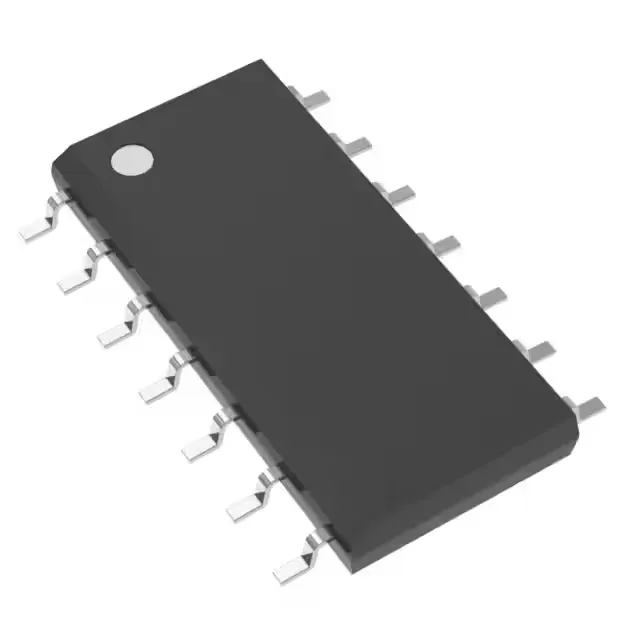
Texas Instruments LinCMOS™ TLC2264CDR, quad general-purpose op-amp, 730 kHz gain bandwidth, 0.55 V/µs slew rate, rail-to-rail output, 1 pA input bias, 850 µA supply per channel, 14-SOIC package.
| Parameter | Value |
|---|---|
| Series | LinCMOS™ |
| Output type | Rail-to-Rail |
| Mounting | Surface Mount |
| Amplifier type | General Purpose |
| Voltage - input offset | 300 µV |
| Voltage - supply span | 4.4 V |
| Current - supply | 850µA (x4 Channels) |
| Current - input bias | 1 pA |
| Current - output (Channel) | 50 mA |
| Operating temperature | 0°C ~ 70°C |
| Gain bandwidth product | 730 kHz |
| Package | Tape & Reel (TR); Cut Tape (CT) |
| Slew rate | 0.55V/µs |
| Case | 14-SOIC (0.154\", 3.90mm Width) |
| Number of circuits | 4 |
Total supply current across all four amplifiers is 850 µA typical at 5 V. The supply range spans 4.4 V to 16 V, so it works from a single lithium cell (boosted) up to a standard 12 V industrial rail.
The TLC2264CDR is a CMOS op-amp with 1 pA input bias current and rail-to-rail output, while the LM324 is a bipolar part with higher bias current and no rail-to-rail swing. In many low-speed signal conditioning circuits the TLC2264CDR can drop in if the supply voltage is at least 4.4 V and the 14-SOIC footprint matches. However, the LM324 has a wider supply range (3 V to 32 V) and a different output voltage swing characteristic, so verify the circuit's input common-mode range and output headroom before substituting.
As a general-purpose CMOS quad op-amp, the TLC2264CDR is used in sensor signal conditioning (photodiode, thermocouple, pH probe), active filters, data acquisition front-ends, portable instrumentation, and multi-channel analog processing where low power and low input bias current are priorities.