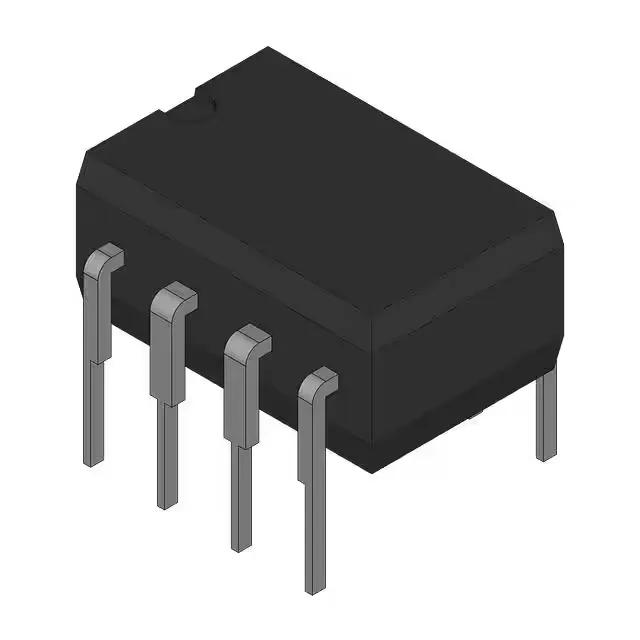
The 1.5 pA input bias current suits high-impedance sources such as photodiode transimpedance stages or pH probe buffers, where bias current errors would otherwise dominate the offset budget. Supply range spans 4.5 V to 16 V, allowing operation from a single 5 V rail or dual ±5 V to ±8 V supplies without a separate regulator.
For a unity-gain buffer, that supports a full-power bandwidth of roughly 300 kHz before slew-rate limiting sets in. The 10 MHz gain-bandwidth product sets the usable closed-loop gain: a gain-of-10 stage maintains flat response to 1 MHz, while a gain-of-100 stage rolls off around 100 kHz. These numbers place the TLC071CP in the mid-speed general-purpose tier — faster than a 741 or LM358, but not intended for video or high-speed data acquisition where 100+ MHz GBW parts are needed.
Package and supply — fit for breadboard and legacy boards
The 8-DIP (0.300" body width) package fits standard breadboards, prototyping sockets, and many existing through-hole PCB layouts. The 4.5 V minimum supply means a single 5 V rail is sufficient, and the 16 V maximum allows ±8 V dual supplies for wider signal swing.