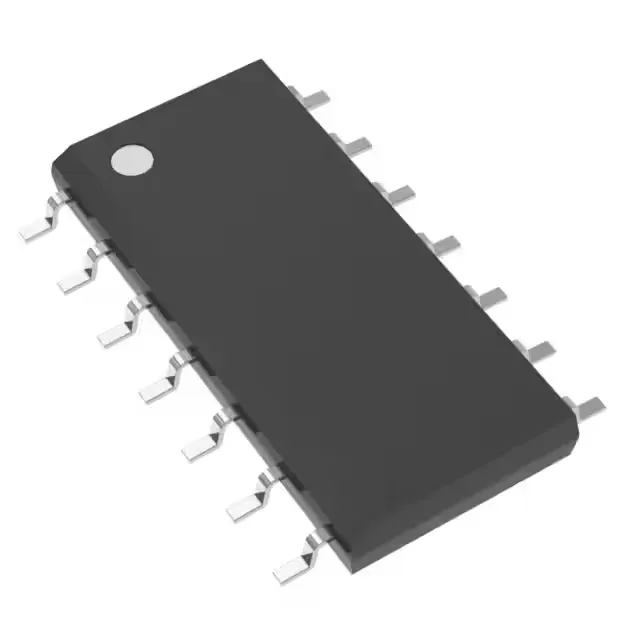
Quad op-amp with 12 MHz GBW and rail-to-rail output
The TL974IDR is a quad-channel general-purpose operational amplifier from Texas Instruments, packing four independent amplifiers into a 14-SOIC package. It delivers a 12 MHz gain-bandwidth product and a 5 V/µs slew rate, which together set the small-signal bandwidth ceiling for each channel. The rail-to-rail output stage swings within millivolts of both supply rails, preserving dynamic range in low-voltage signal chains.
Supply range and current budget
Operating from a single supply as low as 2.7 V up to 12 V, the TL974IDR covers the common 3.3 V, 5 V, and 12 V analog rails. Each amplifier draws 2 mA quiescent current, so the full quad draws 8 mA — a figure that factors into the thermal budget for the 14-SOIC package in a multi-channel design. Each output can source or sink 80 mA, enough to drive a 12-bit SAR ADC input, a 50-ohm transmission line at moderate frequencies, or a small relay coil through a series resistor. The 200 nA input bias current and 1 mV input offset voltage are typical for a general-purpose bipolar stage; for DC-coupled precision below 1 mV, a chopper-stabilized amplifier would be the next step up.
Industrial temperature range and active lifecycle
Rated for -40°C to 125°C operation, the TL974IDR is specified across the full industrial temperature envelope — suitable for engine-bay electronics, outdoor instrumentation, and factory-floor sensor interfaces. Texas Instruments lists the product status as Active, and the device is ROHS3 compliant.
Package and footprint
Housed in a 14-SOIC package with 0.154-inch body width (3.90 mm), the TL974IDR uses a standard surface-mount footprint. The supplier device package is 14-SOIC, and the part is supplied on Tape & Reel or Cut Tape. The 1.27 mm pin pitch is layout-friendly on a two-layer board, with the supply decoupling placed close to pins 4 and 11.