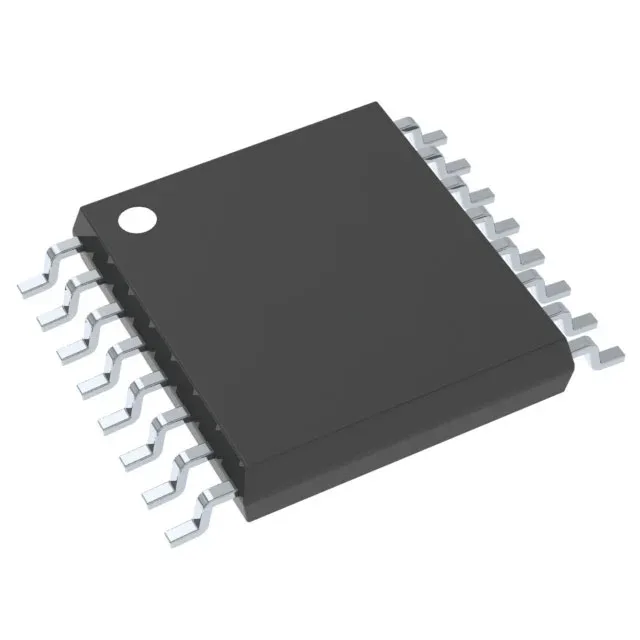
Multi-topology PWM controller for industrial power supplies
The Texas Instruments TL594IPW is a fixed-frequency PWM controller that supports step-up, step-down, and step-up/step-down topologies including buck, boost, flyback, forward converter, full-bridge, half-bridge, and push-pull configurations. It provides two push-pull transistor-driver outputs with a maximum duty cycle of 97%, operating from a 7 V to 40 V supply rail and switching between 1 kHz and 300 kHz.
Switching frequency and duty cycle — design trade-offs
The 1 kHz to 300 kHz switching range lets the designer balance transformer size against core losses: lower frequencies simplify magnetic design but increase component volume; higher frequencies shrink the magnetics but demand faster diodes and careful layout to manage switching losses. A 97% maximum duty cycle means the controller can run near dropout in boost mode or maintain regulation with a narrow input-to-output voltage margin — useful in battery-backed or loosely regulated front-end supplies. Dead-time control and frequency control are available on dedicated pins, allowing the designer to adjust the overlap between output phases and synchronise to an external clock if needed — though the part lacks a dedicated clock sync input.
Designers evaluating this part for a new project should consider the active TL594 family variants in compatible packages or a modern PWM controller with similar topology support, though pin compatibility must be verified against the target footprint.
16-TSSOP footprint and thermal notes
The 16-TSSOP package (0.173" body width, 4.40 mm) is a compact surface-mount option for space-constrained PCBs. There is no exposed thermal pad — junction-to-ambient thermal resistance depends on the copper area on the top and bottom layers and the number of thermal vias under the package.