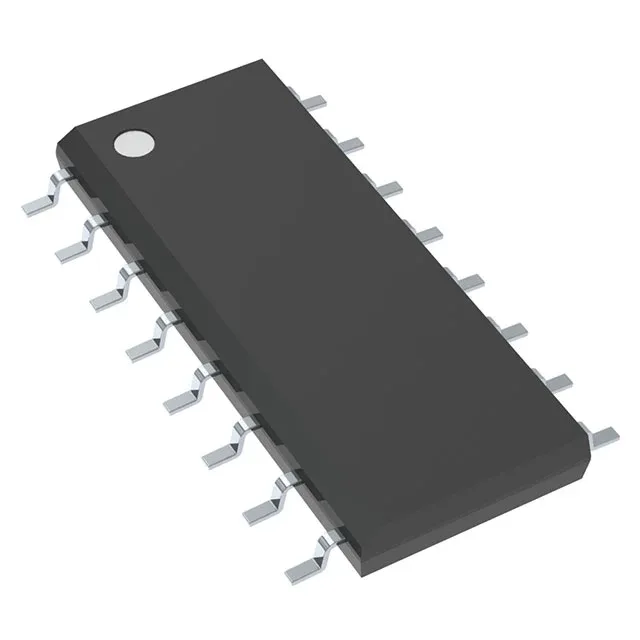
The TL594CD is a fixed-frequency PWM controller from TI that can be configured for step-up, step-down, or step-up/step-down topologies — buck, boost, flyback, forward converter, full-bridge, half-bridge, or push-pull. Its two transistor-driver outputs and 97% maximum duty cycle suit it for applications requiring tight output regulation across a wide input range, such as industrial power supplies, telecom DC-DC converters, and battery-powered equipment. The controller operates from a 7V to 40V supply and switches between 1kHz and 300kHz, giving the designer flexibility to optimise transformer size and switching losses.
Key ratings for your BOM decision
The 97% max duty cycle means the controller can maintain regulation with very little headroom between input and output, which is useful in battery-powered systems where the input voltage sags near the end of discharge. Control features include dead-time control and frequency control, allowing the designer to adjust the overlap between the two output drivers and synchronise the switching frequency to an external clock — though the part does not have a dedicated clock-sync pin.
For new designs, consider the UCC2806DWTR — a dual-output PWM controller with a similar topology set (boost, flyback, forward converter) but a lower 50% max duty cycle and a wider -40°C to 85°C temperature range. The LM5150QURUMRQ1 is an automotive-grade boost controller with AEC-Q100 qualification, but it is a single-output part with a different feature set. The TL594CD is supplied in a tube of 16-SOIC packages.