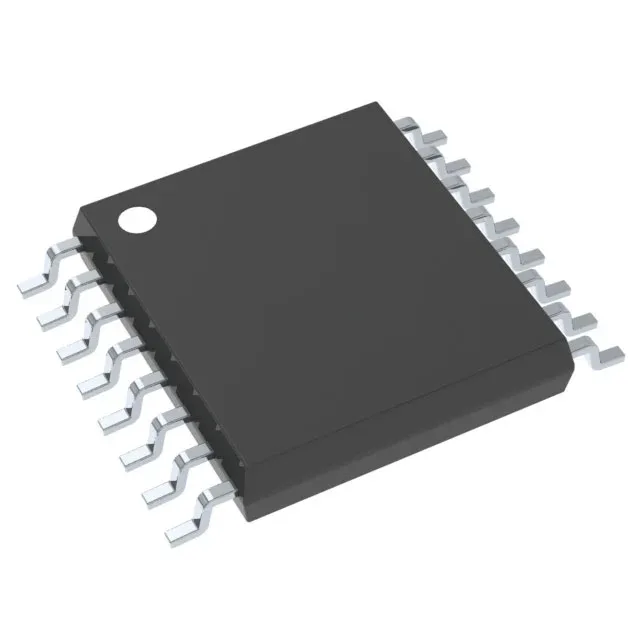
TL494CPWR

Texas Instruments

Texas Instruments TL494CPWR PWM controller, 1 kHz–300 kHz switching frequency, 45% max duty cycle, 7 V–40 V supply, 0°C–70°C, 16-TSSOP.

Texas Instruments TL494CPWR
Download datasheet (PDF)
[IN STOCK] In Stock: 475 pcs
$0.52/ pc

Volume pricing

Buy Now

MOQ 1 · Tape & Reel (TR); Cut Tape (CT) · RoHS · EIA-481 · DAP/DDP · T/T

Technical specifications

TL494CPWR specifications
Parameter / AttributeSpecification / Value
Output typeTransistor Driver
MountingSurface Mount
Voltage - supply (Vcc (Vdd))7V ~ 40V
Frequency - switching1kHz ~ 300kHz
I/O channels2
Output phases1
Duty cycle45%
Operating temperature0°C~70°C(TA)
PackageTape & Reel (TR); Cut Tape (CT)
FunctionStep-Up, Step-Down, Step-Up/Step-Down
TopologyBuck, Boost, Flyback, Forward Converter, Full-Bridge, Half-Bridge, Push-Pull
Clock syncNo
Case16-TSSOP (0.173\", 4.40mm Width)
Control featuresDead Time Control, Frequency Control
Output configurationPositive
Synchronous rectifierNo
100% Footprint Match · Solder-Ready (No PCB Redesign Needed)

Need Stock or a Drop-in Second-Source for TL494CPWR?

Package: DIP-16 / SOIC-16 · Pin-compatible replacements with immediate Shenzhen spot stock

Footprint Match 98%
Supply Chain & Allocation Reality:

The TL494 is the PWM heart of classic ATX supplies, inverters, welders and battery chargers - a 16-pin voltage-mode controller whose real-world identity is a family: KA7500B, MB3759 and IR3M02 are pin-for-pin clones, and repair benches swap them daily. Two traps live here. The first is quality drift inside the clone family - the cheaper suffix revisions (7500C and similar) have documented poorer oscillator and drive behavior, and a supply that squeals under load after a cheap swap is the classic symptom. The second is the SG3525, a functionally similar controller that is not pin-compatible and keeps getting treated as one.

Verified Pin-Compatible Replacements (3 verified alternatives)

KA7500B onsemi (Fairchild line) DIP-16 / SOIC-16
100% Drop-in (Zero Code Change)
Availability & Target Pricing:

The Ubiquitous ATX Clone

Shenzhen Spot Stock (24-48h Dispatch)

Electrical & Core Specs:

Pin-for-pin equivalent of the TL494: same 5V reference, dual error amplifiers, dead-time comparator and dual output transistors - the part most ATX supplies were actually built with.

Same operating envelope as the TL494 (7V to 40V class supply, output stage per the datasheet).

Compatibility & Drop-In Notes: The standard repair swap in both directions. In precision designs one subtlety is worth knowing: the TL494 error-amplifier open-loop gain is slightly higher than the KA7500B, so a marginal compensation network can behave differently at the edges - check the loop if the supply misbehaves after the swap.
Package & Solder Footprint: DIP-16 / SOIC-16 pin-identical; the PCB does not know the difference.
Shenzhen Warehouse Stock & MOQ: Massive stock across fabs - and exactly why suffix verification matters (see checklist).
MB3759 Fujitsu / second-source fabs DIP-16
100% Drop-in (Zero Code Change)
Availability & Target Pricing:

The Japanese-Origin Equivalent

Shenzhen Spot Stock (24-48h Dispatch)

Electrical & Core Specs:

The Fujitsu TL494-equivalent of the same architecture era - same pinout and function, found in Japanese-built supplies of the 1980s-90s.

Same envelope as the family.

Compatibility & Drop-In Notes: Same practical rule as the KA7500B swap - board-level interchange works, precision loops deserve a check after any cross-brand change.
Package & Solder Footprint: DIP-16; verify body markings on old stock.
Shenzhen Warehouse Stock & MOQ: Stocked for repair of legacy Japanese equipment.
SG3525 STMicroelectronics / TI / onsemi DIP-16 / SOIC-16
Functional Equivalent
Availability & Target Pricing:

Same Job, Different Wiring - Do Not Plug In

Shenzhen Spot Stock (24-48h Dispatch)

Electrical & Core Specs:

A voltage-mode PWM controller with a similar mission (8V to 35V supply, 500kHz class, 5.1V reference) but a different internal design: single error amplifier, built-in soft-start and shutdown, totem-pole output stage instead of the TL494 open-collector/emitter transistors.

8V to 35V operating range; 5.1V reference against the TL494 5V.

Compatibility & Drop-In Notes: Listed as the standing warning: the SG3525 is the controller people reach for when a TL494 is unavailable, and it does not fit the socket. Replacing a TL494 design with an SG3525 is a redesign task, not a repair swap.
Package & Solder Footprint: 16 pins, different assignments - inserting one into a TL494 footprint puts supply and outputs on the wrong pads.
Shenzhen Warehouse Stock & MOQ: Widely stocked in its own right; see the PWM family for its own substitution map.
Buyer & Quality Checklist for Sourcing Alternatives
  • Clone quality is suffix-dependent: the KA7500B family is the safe interchange, while cheaper suffix revisions (7500C and no-name equivalents) report poorer oscillator accuracy and drive strength - a supply that squeals or drifts after a cheap swap is showing you the suffix.
  • Pin 13 output-control and the dead-time pin define the topology behavior (push-pull versus single-ended, minimum gap): if a swapped-in part has "different dead-time curves" from the original, the symptom shows at light load.
  • The TL494 error amplifiers are conventionally used with the reference on the non-inverting input and the sensed rail on the inverting input - the reverse of intuition. When touching the feedback network, read the schematic against the part, not against habit.
  • One measurable cross-brand difference worth knowing: TL494 error-amp open-loop gain is specified around 70dB against about 65dB for the KA7500B. In most supplies this is invisible; in precision chargers, verify regulation after a brand swap.
  • The SG3525 lives one shelf away and is not pin-compatible. If a repair needs its features (soft-start, totem-pole drive), the board has to change with it.
  • Keep verified lots: the 16-pin PWM drawer is a classic relabeling target, and the failure mode (frequency drift) is invisible to DC tests.
Frequently Asked Technical Questions

Q: Is KA7500B the same as TL494?

A: Functionally and pin-for-pin, yes - it is the Fairchild-line clone that most ATX supplies were actually built with, and the standard repair interchange in both directions. For precision loops, note the small error-amplifier gain difference when cross-swapping brands.

Q: Can I replace a TL494 with an SG3525?

A: No. Similar job (voltage-mode PWM controller) and the same 16-pin body, but different pinout, different output stage and different support pins. It is a redesign part, not a repair substitution.

Q: Why does my power supply squeal after replacing the PWM chip?

A: Two usual causes: a cheaper clone suffix with poorer oscillator or drive behavior (the known 7500C-class issue), or a marginal compensation network reacting to the cross-brand gain difference. Fit a documented KA7500B/TL494-grade part and re-check the loop.

Technical details

PWM controller for multi-topology power supplies

Control features include dead-time control and frequency control, letting you set the oscillator timing and adjust the overlap between the two outputs. No synchronous rectifier drive or clock sync is built in — this is a straightforward PWM core for isolated and non-isolated designs where you handle the SR externally.

Switching frequency range — transformer sizing

The 1 kHz to 300 kHz range lets you trade off transformer size against core losses. At the low end you use a larger magnetics but get lower switching losses; at the high end you shrink the transformer but need faster diodes and careful layout. The TL494CPWR gives you the flexibility to pick the sweet spot for your power level and cost target.

TL494CPWR
[ALLOC] verified
Quote