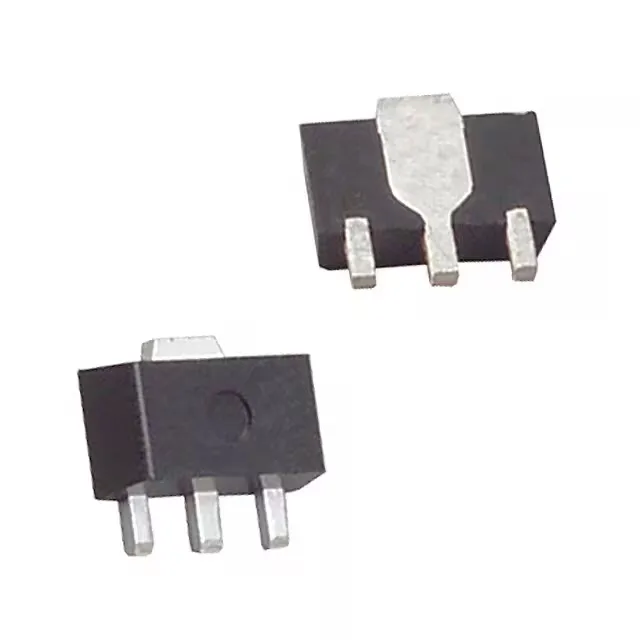
The shunt regulator topology means it sinks current from a supply rail through a series resistor to maintain the reference voltage at the REF pin. This Q-grade variant carries a ±2.2% initial tolerance on the 2.495 V internal reference, which is tighter than the standard ±2.5% grade and looser than the ±1% A-grade. For a 5 V output using a 1% feedback divider, the total regulation band at 25°C works out to roughly ±50 mV before temperature drift. The SOT-89-3 package (TO-243AA) is a medium-power surface-mount package with a large collector tab for heat sinking.
The base product number TL431 spans dozens of package and tolerance variants across multiple manufacturers. Pin compatibility should be verified against the target footprint before substituting.
The 100 mA cathode current rating sets the maximum load the shunt can sink while regulating. In a typical feedback application for a switching power supply, the TL431QPK draws about 1 mA quiescent current through the cathode, leaving 99 mA of headroom for driving the optocoupler LED and bias network. That is plenty for most flyback and forward-converter designs. The 36 V maximum output voltage means this part can regulate rails up to 36 V, covering 24 V industrial supplies, 12 V automotive buses, and 5 V logic rails with margin. The 2.495 V minimum output is the bandgap reference voltage itself — any output below that is not possible without an external negative rail. The SOT-89-3 package's thermal resistance junction-to-ambient is typically around 55°C/W with adequate copper — at 100 mA cathode current and 36 V drop (3.6 W), the part would exceed its maximum junction temperature, so the cathode current and voltage drop must be derated together.