±0.5% tolerance — the accuracy floor for your reference
Its ±0.5% tolerance on the 2.495V internal reference means the output voltage at the regulation point stays within half a percent of the programmed value over the operating temperature range — tight enough for most 8- to 12-bit ADC references and precision comparator thresholds. Output is adjustable from 2.495V up to 36V using two external resistors, making it a drop-in for any TL431 socket where the designer needs a known accuracy grade. The shunt architecture sinks current from a supply through a pull-up resistor, so it works as both a reference and an error amplifier in one package.
The 100 mA output current capability lets this part drive an optocoupler LED directly in a feedback loop, or bias the base of a pass transistor for a linear regulator. The 700 µA minimum cathode current is the standing current needed to keep the reference in regulation — below that the part drops out of its specified accuracy band. In a typical shunt regulator circuit, the pull-up resistor must be sized to deliver at least 700 µA to the cathode at the minimum supply voltage, plus whatever load current the reference sinks. That sets a floor on the resistor value and the power dissipation in the part.
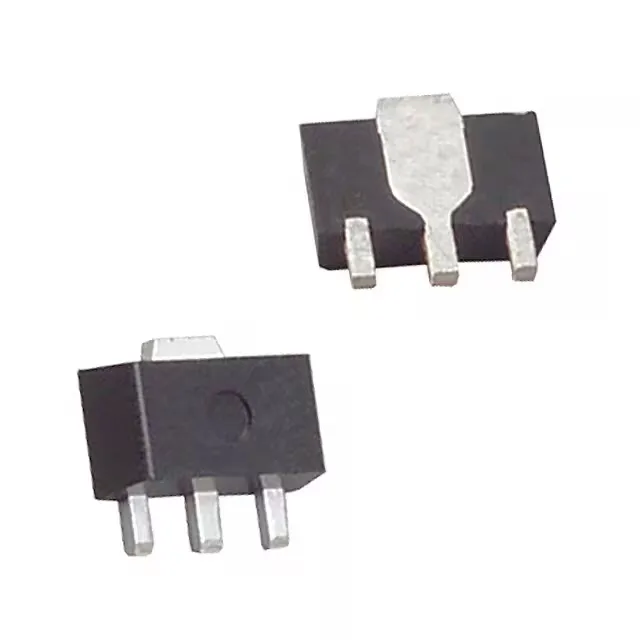
SOT-89-3 package — board-fit and thermal note
The SOT-89-3 (TO-243AA) package is a surface-mount outline with a large collector tab on the back side that doubles as the cathode connection.