Why the ±0.5% tolerance matters for your reference rail
The TL431BILPR is an adjustable shunt voltage reference from the industry-standard TL431 family, but with a tighter ±0.5% tolerance that sets it apart from the common ±1% or ±2% grades. This precision directly determines the accuracy of the output voltage set by the external resistor divider — a ±0.5% reference at 2.495 V means the initial setpoint error is half that of a ±1% part, critical for ADC references, precision regulators, and comparator thresholds where every millivolt counts.
Output voltage range and current capability
The output is adjustable from the 2.495 V minimum up to 36 V maximum via two external resistors, covering common rails like 3.3 V, 5 V, 12 V, and 24 V. The shunt regulator sinks up to 100 mA, so the bias resistor from the supply to the cathode must be sized to deliver at least 700 µA of cathode current at all times — even at no load — to keep the regulation loop stable. At full load, the resistor drops the difference between the supply and the output voltage at 100 mA, so power dissipation in both the resistor and the TL431BILPR needs a quick thermal check.
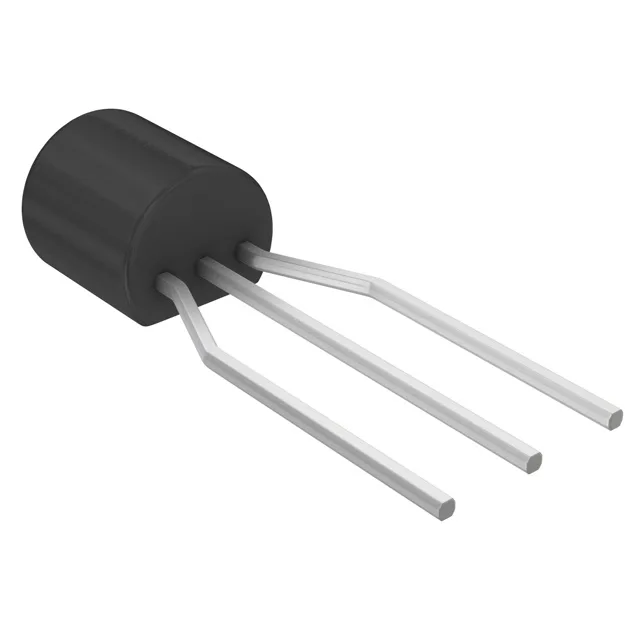
The through-hole TO-92-3 package with formed leads is a workhorse for prototyping, low-volume production, and designs where board space is not the constraint. The leads are formed for direct PCB insertion or socketing, and the package body is the standard TO-226AA outline.
That means no last-time-buy scramble and no forced redesign for a replacement.