Shunt reference with ±1% tolerance — what that buys you
Its ±1% tolerance at 25 °C means the initial reference voltage at the REF pin is within 1 % of 2.495 V — tight enough for most 8-bit ADC references, feedback loops in isolated power supplies, and comparator thresholds without external trimming. Output voltage is set by two external resistors anywhere from 2.495 V up to 36 V, covering the common 3.3 V, 5 V, and 12 V rail references. The shunt architecture sinks current from a positive supply through a pull-up resistor, so it works as a floating reference or as a negative rail reference with the anode tied to a negative supply.
100 mA output — load and bias headroom
The TL431ACPK can sink up to 100 mA continuous cathode current. In a typical shunt regulator configuration that current is the sum of the bias current through the pull-up resistor and the load current drawn from the reference node. A 100 mA ceiling gives comfortable headroom for driving optocoupler LEDs in feedback loops, biasing a string of comparators, or supplying a small local reference rail — the 600 µA minimum cathode current keeps the device in its linear region even at light load.
Texas Instruments still manufactures this variant, so there is no last-time-buy deadline or forced redesign.
Package and temperature — board-fit details
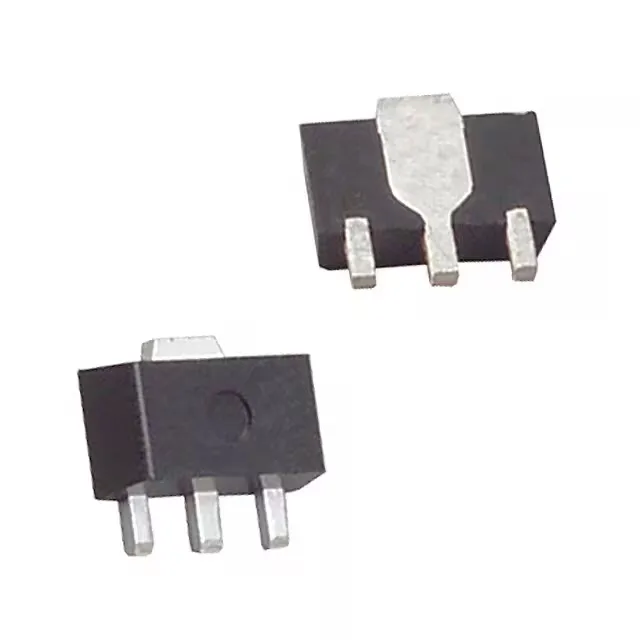
The TL431ACPK is supplied in a TO-243AA (SOT-89-3) package with the standard pinout: cathode (tab), anode, and reference. The wide tab on the SOT-89-3 provides a low thermal resistance path to the board — useful when sinking the full 100 mA at elevated ambient.