What this PWM controller does in a power stage
The Texas Instruments TL1451CN is a dual-output PWM controller that handles step-up, step-down, and step-up/step-down conversion across buck, boost, and flyback topologies — a single IC that covers the three most common non-isolated and isolated power stage architectures. The switching frequency spans 1 kHz to 500 kHz, set by an external RC network, so you tune the magnetics size against the switching loss trade-off.
Package and board-fit for a through-hole design
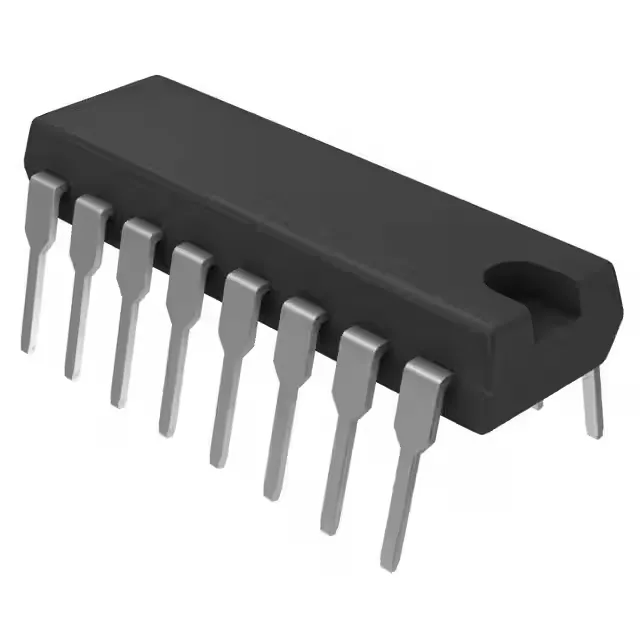
The supplier device package is 16-PDIP. The tube packaging means it ships in the standard anti-static tube for DIP devices — no reel, no carrier tape. For a small-run or repair BOM, this is the expected format.
Output stage and control features
Two transistor-driver outputs, each capable of driving an external MOSFET or bipolar switch, with a single output phase per channel. The output configuration is positive — the driver sources current to the gate or base. Control features include frequency control via an external timing resistor and capacitor — no internal oscillator lock. There is no clock sync input, so synchronizing multiple controllers to a common clock requires an external oscillator feeding the RT/CT pin. There is no synchronous rectifier output — the TL1451CN drives the primary-side switch only. For the secondary side, you add an external synchronous rectifier controller or use a Schottky diode.
Temperature grade and operating environment
Rated for -20°C to +85°C ambient — the commercial/industrial temperature band. It is not specified for -40°C cold start, so an outdoor enclosure in a -30°C winter needs a heater or a wider-temp part.