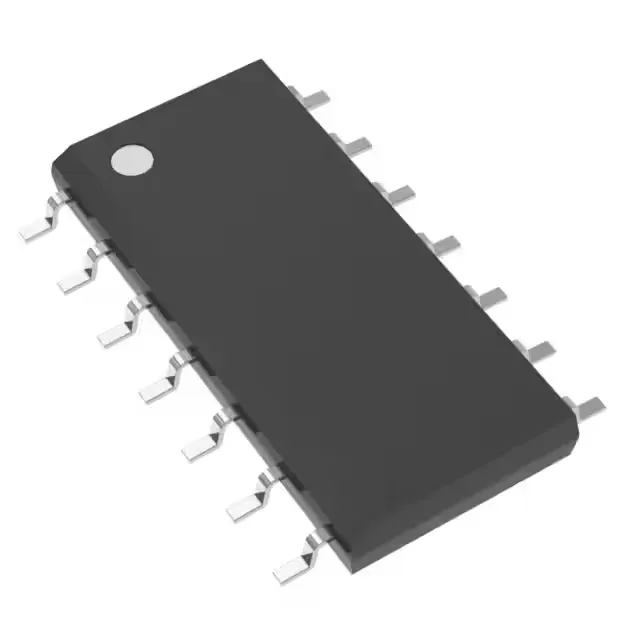
JFET input stage — the reason this part exists
The TL084ACDRE4 is a quad JFET-input operational amplifier from Texas Instruments. The JFET input stage gives it a typical input bias current of 30 pA — orders of magnitude lower than a bipolar-input op-amp — which matters when the source impedance is high and you cannot afford DC offset from bias current flowing through a feedback network or sensor.
13V/µs slew rate and 3 MHz GBW — what they mean for signal fidelity
A 13V/µs slew rate means this op-amp can swing a 10 V peak-to-peak output at frequencies up to roughly 200 kHz before slew-rate limiting distorts the waveform. The 3 MHz gain-bandwidth product sets the usable closed-loop gain: at a gain of 10 the -3 dB bandwidth is about 300 kHz. For audio-frequency paths — line-level signals below 20 kHz — both numbers provide ample headroom with negligible slew-induced distortion.
Supply range and power budget across four channels
The TL084ACDRE4 operates from a total supply span of 10 V to 30 V — that covers ±5 V to ±15 V dual supplies or a single 10 V to 30 V rail. Total supply current is 1.4 mA for all four amplifiers, which keeps the power dissipation low in the 14-SOIC package.
It belongs in indoor equipment, benchtop instruments, audio gear, and office electronics.
14-SOIC package and Tape & Reel — assembly and procurement notes
The 14-SOIC (0.154-inch body width, 3.90 mm) footprint is a standard surface-mount package, widely second-sourced and easy to lay out on two-layer boards.