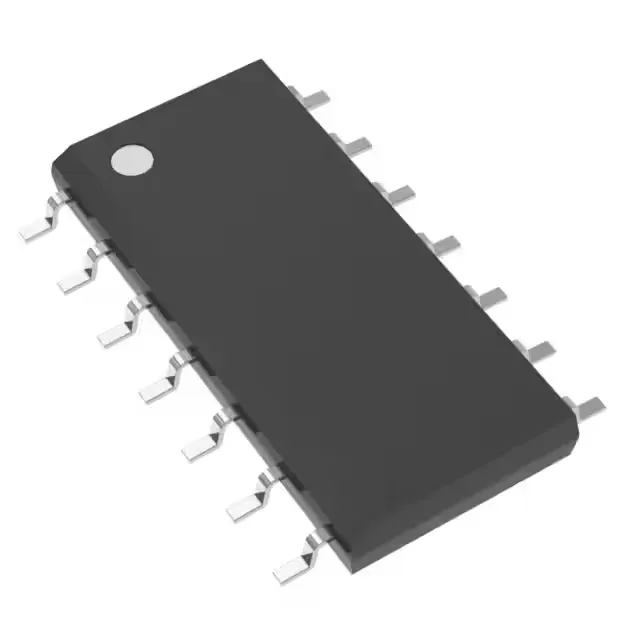
Its 3 MHz gain-bandwidth product and 13V/µs slew rate support signal conditioning up to several hundred kilohertz before gain roll-off limits the bandwidth.
Supply budget and input characteristics
Each of the four amplifiers draws 1.4 mA, totalling 5.6 mA for the package — a reasonable quiescent budget for a multi-channel board where the op-amp power isn't the dominant rail load. Input bias current is 65 pA typical, a direct benefit of the JFET input stage. That keeps voltage error low when the source impedance is high — think photodiode transimpedance stages or pH probe buffers where a bipolar op-amp's nanoamp bias would swamp the signal. For a general-purpose quad this is unremarkable; if the application requires sub-millivolt precision, a trim or a chopper-stabilised part is the better fit.
It is RoHS compliant, as the 'G4' suffix indicates, so it passes the typical restricted-substance screening for new designs.