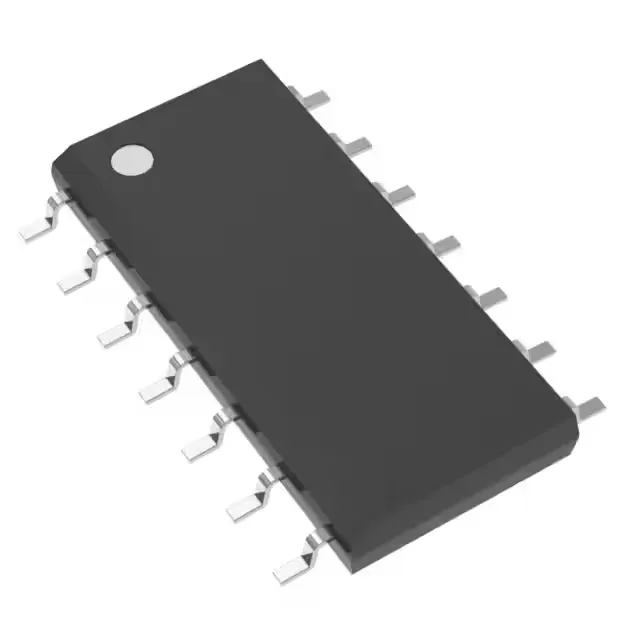
Texas Instruments TL074ACDR — Analog & Data Acquisition

TL074ACDR JFET Quad Op-Amp, 3 MHz, 13 V/µs, 14-SOIC

MPNTL074ACDR
Active

Texas Instruments TL074ACDR, JFET quad op-amp, 3 MHz gain bandwidth, 13 V/µs slew rate, 1.4 mA per channel supply, 14-SOIC package, 0°C to 70°C operating temperature.

$0.9800Ref. price · indicative, final on quote
Independent supplier — new & surplus stockAuthenticity-screened · ESD-safe packingListing updated Jul 2026

Specifications

TL074ACDR specifications
ParameterValue
MountingSurface Mount
Amplifier typeJ-FET
Voltage - input offset3 mV
Voltage - supply span30 V
Current - supply1.4mA (x4 Channels)
Current - input bias65 pA
Operating temperature0°C~70°C(TA)
Gain bandwidth product3 MHz
PackageTape & Reel (TR); Cut Tape (CT)
Slew rate13V/µs
Case14-SOIC (0.154\", 3.90mm Width)
Number of circuits4

Product details

JFET quad op-amp for signal conditioning

Its JFET input stage delivers 65 pA typical input bias current, making it a fit for high-impedance sensor interfaces, audio preamplifiers, and active filter stages where input loading must be minimised.

Supply range and channel budget

Operates from a 10 V to 30 V total supply span — single or split rails — and draws 1.4 mA per amplifier, totalling 5.6 mA for all four channels. The 3 mV typical input offset voltage keeps DC errors manageable in precision gain blocks without external trimming.

It is not specified for automotive or extended-industrial ambient extremes.

Frequently asked questions

What is the difference between TL074ACDR and TL074CN?

The TL074ACDR is the surface-mount variant in a 14-SOIC package, while the TL074CN is the through-hole DIP-14 version. Electrical characteristics — 3 MHz GBW, 13 V/µs slew rate, JFET input — are shared across the TL074 family; the package selection drives the board assembly process.

Is TL074ACDR compatible with other TL074 package variants?

Pin-compatible within the TL074 family — the 14-SOIC (TL074ACDR) and DIP-14 (TL074CN) share the same pinout and electrical specifications, differing only in footprint and thermal characteristics. A board designed for the SOIC footprint cannot accept a DIP part without an adapter.