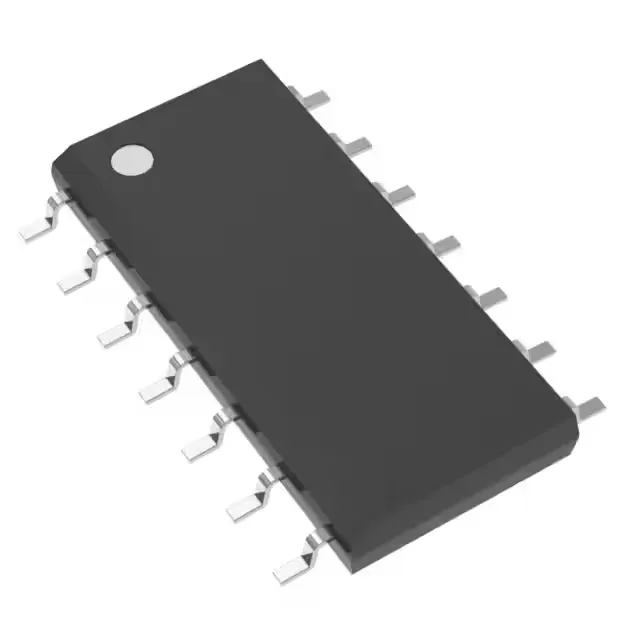
Quad JFET op-amp for low-power signal conditioning
The JFET input stage delivers 30 pA input bias current, which keeps the voltage error small when the source impedance is high — think photodiode transimpedance stages, piezo sensor buffers, or precision integrators where a bipolar input's base current would swamp the signal. Each of the four amplifiers draws 200 µA of supply current, so the whole package runs under 1 mA quiescent. That makes this a good fit for multi-channel battery-powered instruments or any board where the op-amp rail budget is tight.
The slew rate limits the large-signal bandwidth to roughly 55 kHz at 10 V peak-to-peak output. For audio or low-frequency instrumentation loops that's fine; for a switching waveform or a fast ADC driver you'll want a faster part. The 20 mA per-channel output drive is adequate for driving the feedback network and a following stage, but don't count on it for a 50 Ω line or a heavy capacitive load without a series resistor.
If the board sees an engine bay, a rooftop enclosure, or a freezer, step up to the industrial-grade TL064 variant.