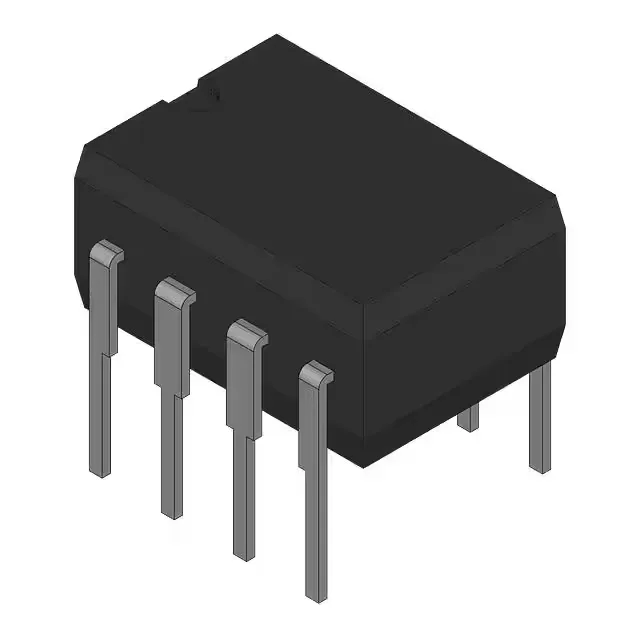
The 20 V/µs slew rate and 3.1 MHz gain-bandwidth product put it ahead of general-purpose JFET amps like the TL081 for fast signal conditioning — think high-speed data acquisition front-ends, active filters, or waveform generation where the output must swing quickly without slew-rate limiting. Input bias current is 30 pA, typical for a JFET input stage, so it won't load high-impedance sources like photodiode or piezoelectric sensors. The 8-CDIP hermetic ceramic package is the key differentiator: this is a part sized for environments where moisture, outgassing, or wide temperature cycling rule out plastic DIP — avionics, satellite payloads, downhole instrumentation, and military systems that specify ceramic dual-in-line packages.
The TL051AIJG operates from a 10 V to 30 V total supply span, so it works on ±5 V to ±15 V split rails or a single-ended 10 V to 30 V supply. That 30 V maximum is comfortable in industrial 24 V systems with margin. For a precision analog front-end, the 590 µV input offset voltage is adequate for 12-bit systems; if you need sub-100 µV offset, you would step to a precision JFET amp like the OPA140 series.
The 80°C upper limit is fine for most indoor industrial, test equipment, and telecom chassis applications. If the design needs to live in an engine bay or near a hot power stage, you would need the wider-range TL051A variant or a different package. The hermetic CDIP still gives moisture resistance beyond what a plastic DIP offers, so it is a common choice for sealed modules and conformal-coated assemblies where the board sees condensation cycles.
This is not a shortage-era allocation part; it is a mature, steady-supply device. The RoHS status is listed as non-compliant, which is expected for a hermetic ceramic DIP — the lead finish is typically tin-lead solder dip, not pure tin. That means it is exempt from RoHS for high-reliability applications and is the preferred version for military and aerospace builds that require tin-lead terminations.