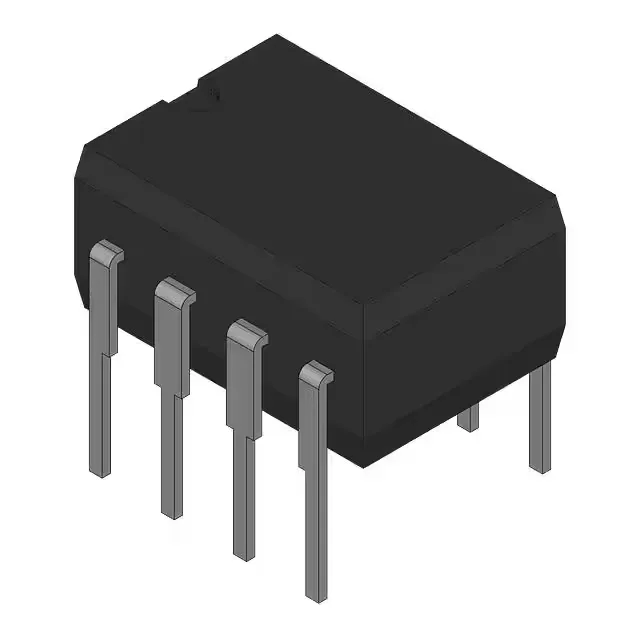
It delivers a 240 V/µs slew rate and 70 MHz gain-bandwidth product, with a supply range from 9 V to 32 V and output current capability of 100 mA per channel. The military temperature range (-55 to 125 °C) and through-hole ceramic package suit it for avionics, missile guidance, satellite payloads, and downhole instrumentation where high slew rate and wide bandwidth are needed to drive coaxial cables, flash ADCs, or pulse circuits.
For a 10 V peak-to-peak output, the full-power bandwidth is roughly 3.8 MHz — beyond that, the output becomes slew-rate limited. This makes the THS4051MJG a fit for video distribution, high-speed pulse amplification, and waveform generation where preserving edge rates matters. The 70 MHz small-signal bandwidth supports gain-bandwidth product up to 70 MHz, so closed-loop gain of 10 still yields 7 MHz of usable bandwidth.
8-CDIP: why the package matters for the BOM
It is hermetic, rated for the full -55 to 125 °C range, and handles the thermal dissipation of 100 mA output current without an exposed pad. The through-hole mounting means the board needs drilled plated-through holes — no reflow profile, but a wave-solder or hand-solder step. For a high-reliability assembly, the ceramic body also resists moisture and outgassing better than plastic DIPs.
For a BOM line requiring a military-temperature, high-slew-rate op-amp in a ceramic DIP, this part is available for both new-design qualification and ongoing production replenishment.