7300 V/µs current-feedback amplifier for high-speed pulse and line-drive
Supply range from 10 V to 30 V gives flexibility for ±5 V to ±15 V rails, common in test equipment and industrial signal conditioning that needs to swing ±10 V into a load.
Slew rate is the limiting factor for large-signal bandwidth in any amplifier. At 7300 V/µs, this part can swing a 20 V peak-to-peak output at roughly 58 MHz before the slew rate starts distorting the sine wave — well above what most video or pulse applications need. For comparison, a typical 100 MHz voltage-feedback op-amp with a 200 V/µs slew rate would start slewing on that same 20 V swing below 3 MHz. The THS3095DDAR keeps the output clean across the full 235 MHz -3 dB small-signal bandwidth. Because this is a current-feedback architecture, the -3 dB bandwidth stays relatively flat across gain settings — you do not lose bandwidth the way a voltage-feedback amp does when you close the loop for higher gain. That makes it predictable in variable-gain stages.
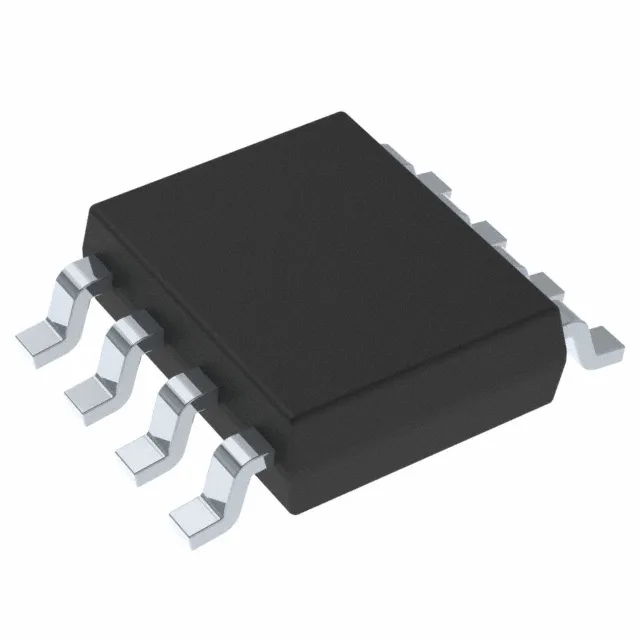
PowerSOIC-8 with thermal pad — the package is part of the spec
Without that thermal path, the 280 mA output current at high slew rates will push the junction temperature past the 85°C operating limit in still air. The pad is the primary heat path — the plastic leads alone cannot handle the dissipation. The package footprint matches the standard SOIC-8 land pattern with an extra thermal-land area under the body. Layout guides from TI recommend a 4-via array in the pad area to stitch the top copper to an inner ground plane.