It integrates two separate CAN channels, each with its own driver and receiver, allowing a single IC to interface two CAN controllers to the bus or support redundant bus architectures.
8 Mbps data rate and CAN FD readiness
The transceiver supports a data rate of 8 Mbps, which is sufficient for CAN FD (Flexible Data Rate) networks that require higher payload throughput than classical CAN. The 8 Mbps rating covers the faster data phase of CAN FD frames, so this part can be used in designs that need to move beyond the 1 Mbps ceiling of traditional CAN. The receiver hysteresis of 100 mV helps reject noise on the bus, which is important for signal integrity at these higher speeds, especially in electrically noisy automotive environments.
Dual-channel architecture — two independent CAN interfaces in one package
With two drivers and two receivers (2/2), the TCAN1046DMTRQ1 provides two independent CAN channels in a single 14-VSON package. This is useful for designs that need to connect two separate CAN buses (e.g., a primary and a secondary bus for redundancy, or a gateway node bridging two CAN segments). Compared to using two single-channel transceivers, this dual-channel approach saves board area and reduces component count. The full-duplex capability per channel means each channel can transmit and receive simultaneously, which is standard for CAN transceivers but worth noting for engineers new to the protocol.
Supply range and operating conditions
The 5 V supply is typical for CAN PHY layers, and the 4.5 V minimum gives some headroom for supply droop during cranking events.
Package and mounting for automotive assembly
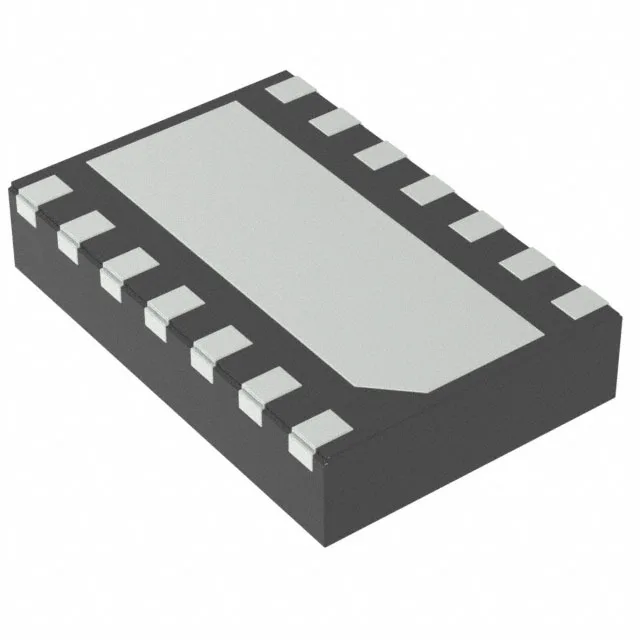
The TCAN1046DMTRQ1 comes in a 14-VDFN package with an exposed pad (also designated as 14-VSON 4.5x3). The exposed pad provides a low thermal resistance path to the PCB, which helps dissipate heat when the transceiver is driving the bus at high data rates. The package supports surface-mount assembly with wettable flanks, which improves solder joint inspection (AOI) and reliability in automotive production.
The ROHS3 compliance ensures it meets the latest environmental restrictions for automotive and consumer markets.