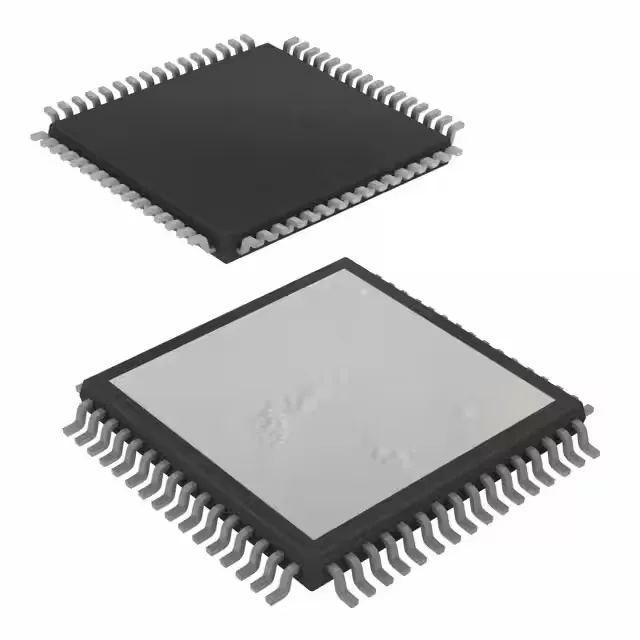
Output power and supply rail — the fit decision
The TAS5613APHDR delivers 300 W into a single 2-ohm load in mono mode, or 200 W per channel into 3-ohm loads in stereo mode — these are the numbers that decide whether the amp can drive the target speaker impedance at the required SPL without clipping. Supply voltage spans 18 V to 38 V, so the same part can run from a regulated 24 V industrial rail or a 36 V battery string; the output power scales with the rail, not the load alone.
Package, footprint and reflow reality
Housed in a 64-TQFP with an exposed thermal pad, the 64-HTQFP (14x14 mm) package requires a good solder-joint inspection plan — the centre pad is the primary heat path, and a void under it pushes junction temperature past the 70°C ambient rating.
Protection features that keep the line running
On-chip short-circuit and thermal protection mean the amp shuts itself down before the output stage or the PCB trace fails — this is what keeps a production test station from blowing a batch of boards during a faulted load test. Depop (pop-reduction) circuitry suppresses the turn-on thump that would otherwise couple through the speaker and annoy the end customer; differential inputs reject ground noise in a multi-channel system.
Lifecycle and compliance — no surprises for the BOM
ROHS3 compliant, which covers the full ten-substance restriction plus the four phthalates; no exemption expiry to track.