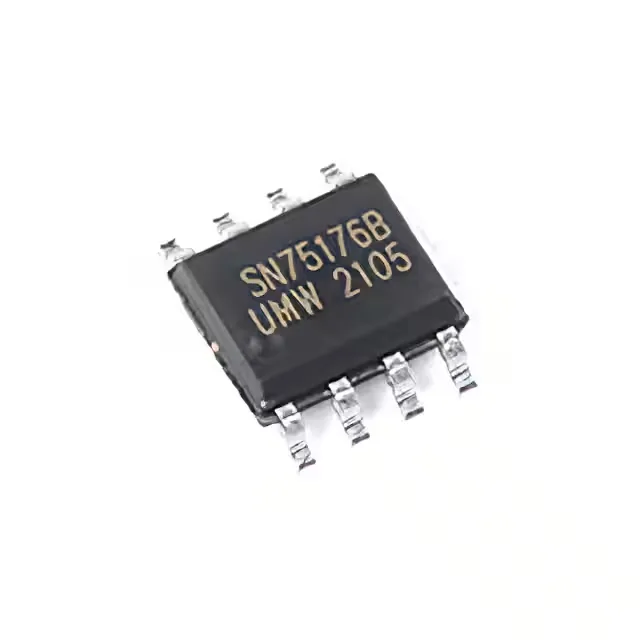
Texas Instruments SN75176BDR — Interface & Transceivers

SN75176BDR RS-485/RS-422 Transceiver, Half-Duplex, 5V

MPNSN75176BDR
Active

Texas Instruments SN75176BDR, RS-422/RS-485 transceiver, half-duplex, 1/1 drivers/receivers, 4.75-5.25V supply, 50 mV hysteresis, 0-70°C, 8-SOIC package.

$0.26037Ref. price · indicative, final on quote
Packaging8-SOIC (0.154", 3.90mm Width)
RoHSROHS3 Compliant
Independent supplier — new & surplus stockAuthenticity-screened · ESD-safe packingListing updated Aug 2026

Specifications

SN75176BDR specifications
ParameterValue
TypeTransceiver
MountingSurface Mount
Supply voltage4.75V ~ 5.25V
ProtocolRS422, RS485
Operating temperature0°C~70°C
DuplexHalf
PackageTape & Reel (TR); Cut Tape (CT)
Case8-SOIC (0.154\", 3.90mm Width)
Receiver hysteresis50 mV
Number of drivers (Receivers)1/1

Product details

What this RS-485 transceiver is and where it goes

5 V rail and 0-70°C — the envelope that decides fit

The supply is strictly 5 V nominal — no 3.3 V option, no wide-range regulator trick. If your board runs a 3.3 V-only bus, this part needs its own 5 V rail or a level translator. The 50 mV hysteresis is generous enough to hold a clean logic level on a long stub without external biasing resistors, but the fail-safe biasing is not internal — an idle bus floats, so you add pull-up and pull-down resistors on the A and B lines if the receiver must output a known state when the cable is disconnected.

Frequently asked questions

What is the difference between SN75176 and SN75176BDR?

The SN75176BDR is the tape-and-reel packaged variant of the base SN75176. The die, the electrical specifications, the 8-SOIC package body, and the operating temperature range are identical. The BDR suffix simply indicates the reel format for automated pick-and-place assembly lines.

Can SN75176BDR be used for RS-485?

Yes. The SN75176BDR is explicitly specified for both RS-422 and RS-485 protocols. It is a half-duplex transceiver, so it drives the differential pair in one direction at a time — you control the driver enable pin to switch between transmit and receive on a shared two-wire bus. The 50 mV hysteresis and 5 V differential output swing meet the RS-485 standard for cable runs up to several hundred metres at data rates up to several megabits per second.