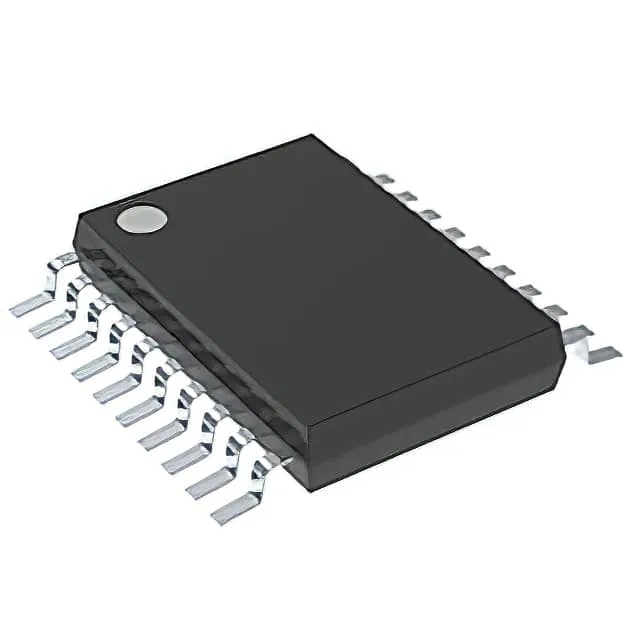
Texas Instruments SN74LVC374APWR — Logic ICs

SN74LVC374APWR D-Type Flip-Flop, 100 MHz, 20-TSSOP

MPNSN74LVC374APWR
End of Life

Texas Instruments 74LVC series SN74LVC374APWR, D-Type flip-flop, positive edge trigger, tri-state non-inverted outputs, 8-bit, 100 MHz, 1.65V-3.6V supply, 24mA output, -40°C to 85°C, 20-TSSOP.

$0.6Ref. price · indicative, final on quote
Packaging20-TSSOP (0.173", 4.40mm Width)
RoHSROHS3 Compliant
Series74LVC
Independent supplier — new & surplus stockAuthenticity-screened · ESD-safe packingListing updated Aug 2026

Specifications

SN74LVC374APWR specifications
ParameterValue
TypeD-Type
Series74LVC
Output typeTri-State, Non-Inverted
Trigger typePositive Edge
MountingSurface Mount
Supply voltage1.65V ~ 3.6V
Current - quiescent10 µA
Current - output high, low24mA, 24mA
Clock frequency100 MHz
Operating temperature-40°C ~ 85°C (TA)
PackageTape & Reel (TR); Cut Tape (CT)
FunctionStandard
Case20-TSSOP (0.173\", 4.40mm Width)
Input capacitance4 pF
Number of elements1
Number of bits per element8
Max propagation delay @ v, max CL7ns @ 3.3V, 50pF

Product details

Octal D-type with tri-state bus interface

The Texas Instruments SN74LVC374APWR is an octal D-type flip-flop from the 74LVC logic family, clocked on the positive edge with tri-state, non-inverted outputs. Eight flip-flops in a single 20-TSSOP package, each with its own D input and Q output, sharing a common clock (CLK) and output enable (OE). The tri-state outputs let you connect this part directly to a shared data bus and float the outputs when OE is high — standard for memory interfaces, microcontroller port expansion, and address/data latching in industrial control boards. The 100 MHz clock frequency handles typical microcontroller bus speeds and moderate-speed data acquisition pipelines.

100 MHz clock and 7 ns propagation delay

Maximum clock frequency is 100 MHz. At 3.3 V with a 50 pF load, propagation delay is 7 ns max.

Active production — no end-of-life risk on this line

No NRND notice, no last-time-buy window to track. ROHS3 compliant — no exemption issues for EU-market builds.

Frequently asked questions

Does SN74LVC374APWR have tri-state outputs?

Yes. The outputs are tri-state, non-inverted. Driving the output enable (OE) pin high puts all eight Q outputs into a high-impedance state, letting you share a bus with other devices.

What are the equivalent parts for SN74LVC374APWR?

The 74F374SCX-NS is a functional peer — also an octal D-type with tri-state outputs and positive-edge trigger. Key differences: the 74F374 runs on 4.5 V supply (not 1.65-3.6 V), has a 140 MHz clock, and is rated for commercial temperature (0°C to 70°C) only. Choose the 74F374 if you need the higher speed and already have a 5 V rail; choose the SN74LVC374APWR for mixed-voltage or industrial-temperature designs.

What is the difference between SN74LVC374APWR and SN74LVC374APW?

The two are electrically identical — same die, same specs. The difference is packaging: SN74LVC374APWR ships in Tape & Reel (for automated pick-and-place), while SN74LVC374APW ships in Tube (for bench builds or low-volume hand assembly). Order the reel variant for production, the tube variant for prototypes.