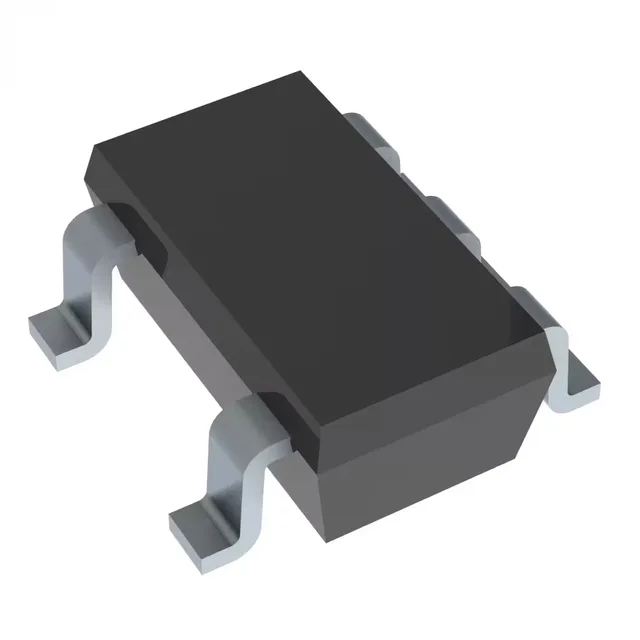
Single-bit D-type flip-flop in SOT-23-5 — what the 160 MHz toggle rate buys you
It belongs to the 74LVC family, designed for 1.65V to 5.5V operation, which means it can bridge 1.8V, 2.5V, 3.3V, and 5V logic domains without a separate level shifter. The 160 MHz maximum clock frequency sets the upper bound for synchronous data capture — at that rate, the flip-flop can latch a new data word every 6.25 ns, suitable for high-speed register pipelines, address decoding, or state-machine storage in FPGA-less glue logic. The propagation delay of 4.5 ns at 5V with a 50 pF load gives the board designer a concrete timing budget: that 4.5 ns is the time from clock edge to valid Q output, which must fit within the setup-and-hold window of the downstream device. With a symmetric 32 mA output drive, this part can directly sink or source enough current to toggle an optocoupler LED or a small-signal relay coil, saving a discrete transistor per channel.
The 1.65V to 5.5V supply range covers the three most common digital rails — 1.8V, 3.3V, and 5V — so the same part can serve in a low-power IoT node (1.8V) and a legacy industrial PLC (5V) without a voltage translator. The 10 µA quiescent current is low enough that the flip-flop's static draw is negligible in battery-powered designs; the dynamic power scales with the 4 pF input capacitance and the toggle rate.
For BOM lines that need a dual-source hedge, the 74LVC1G79 base number is shared across several package variants — the DBVR suffix is the SOT-23-5 tape-and-reel option; the same die in a different package (e.g., DCKR in SC-70) is a drop-in functional equivalent if the footprint allows.