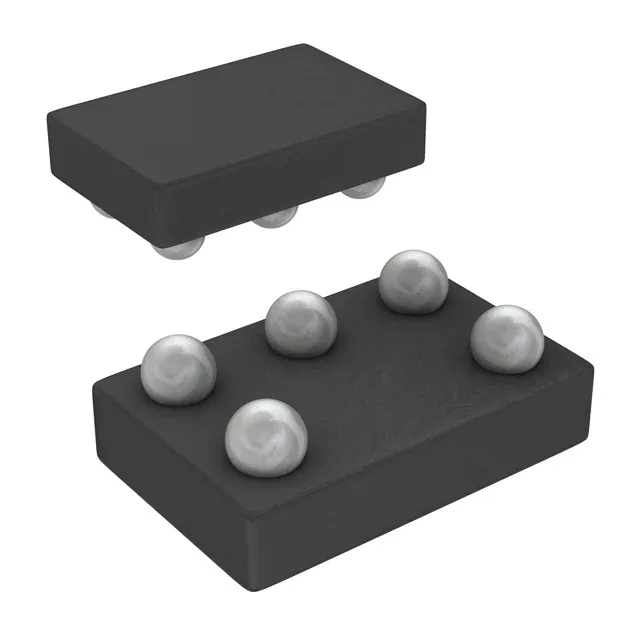
Texas Instruments SN74LVC1G66YEPR — Analog & Data Acquisition

SN74LVC1G66YEPR SPST Analog Switch, 10 Ohm, 300 MHz, DSBGA-5

MPNSN74LVC1G66YEPR
Obsolete

Texas Instruments SN74LVC1G66YEPR, SPST-NO analog switch, 10 Ohm max on-resistance, 300 MHz bandwidth, 1.65 V to 5.5 V supply, -40°C to 85°C, 5-DSBGA (1.4x0.9 mm) package.

$0.1900Ref. price · indicative, final on quote
Independent supplier — new & surplus stockAuthenticity-screened · ESD-safe packingListing updated Jul 2026

Specifications

SN74LVC1G66YEPR specifications
ParameterValue
MountingSurface Mount
Voltage - supply, single (V+)1.65V ~ 5.5V
Current - leakage (IS(off))100nA
Operating temperature-40°C~85°C(TA)
-3db bandwidth300MHz
PackageTape & Reel (TR); Cut Tape (CT)
Case5-XFBGA, DSBGA
Switch circuitSPST - NO
Number of circuits1
On-State resistance10Ohm
Switch time (Ton, toff)4.2ns, 5ns
Multiplexer (Demultiplexer circuit)1:1
Channel capacitance (CS(off), CD(off))6pF

Product details

SPST analog switch in a 0.9 mm pitch BGA

The SN74LVC1G66YEPR is a single-pole single-throw normally-open analog switch from TI's LVC family, built for surface-mount assembly in a 5-bump DSBGA package measuring 1.4x0.9 mm. It handles both analog and digital signals with a 300 MHz -3 dB bandwidth and a maximum on-resistance of 10 Ohm.

10 Ohm on-resistance and 300 MHz bandwidth — signal integrity ceiling

With 10 Ohm max on-resistance, the insertion loss through the switch stays low for signals up to several hundred megahertz. The 300 MHz bandwidth supports video, RF envelope, or high-speed digital paths without significant attenuation. Break-before-make switching is inherent to the SPST-NO topology, with a maximum turn-on time of 4.2 ns and turn-off of 5 ns.

The 5-DSBGA package (1.4x0.9 mm) requires a fine-pitch PCB process and careful stencil design for solder paste deposition.

Frequently asked questions

Where can I buy SN74LVC1G66YEPR?

The part is obsolete and sourced through independent distribution. Submit an RFQ for current availability and pricing — each order is quoted against the specific quantity and date-code requirement.