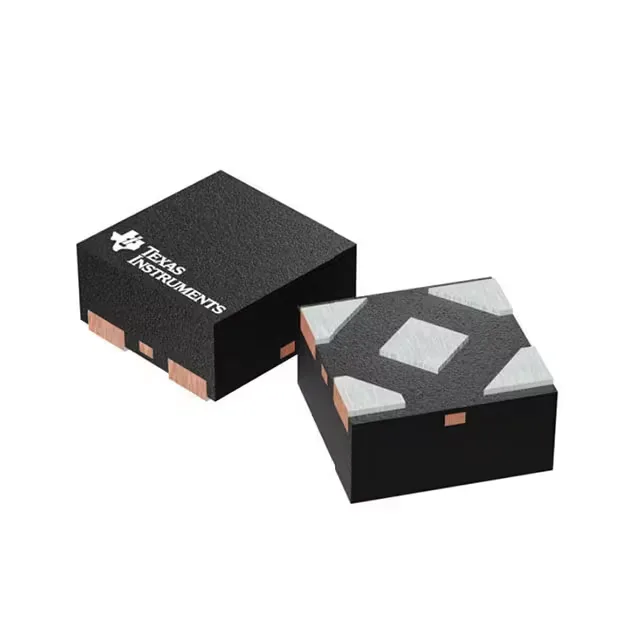
The SN74LVC1G38DPWR: The open-drain output allows wired-OR connections and level translation — the output can be pulled up to a voltage different from VCC.
Max propagation delay is 4.4ns at 5V with a 50pF load. That's fast enough for most board-level glue logic — address decoding, enable gating, or interrupt combining — but if you're stitching together a high-speed memory interface or a clock tree, you'll want to check the timing margin against your system's cycle time. The output can sink 32mA when low (the open-drain pulls to ground), but it cannot source current — the pull-up resistor does that. For a 3.3V rail with a 10kΩ pull-up, the rise time is dominated by the RC time constant, not the gate. Quiescent current is 10 µA max, so it won't burden a battery-powered design.
Package and footprint — hand-solderable?
The SN74LVC1G38DPWR comes in a 5-X2SON package measuring 0.8mm x 0.8mm — that's tiny. The supplier device package is 5-X2SON (0.8x0.8), and the case code is 4-XFDFN Exposed Pad. It's surface-mount only, and hand-soldering this requires a steady hand, a fine tip, and probably a microscope. If you're prototyping on a breadboard, you'll want a breakout board or a larger-package alternative like the SOT-23 version (if available in the same logic function). The exposed pad helps with thermal management if the gate is switching at high frequency, but for a single gate the dissipation is negligible.
If you're designing for under-hood or engine-bay temperatures, look for a 74LVC part with an AEC-Q100 qualification. For most indoor and outdoor sheltered equipment, this temperature grade is fine.
It is ROHS3 compliant.