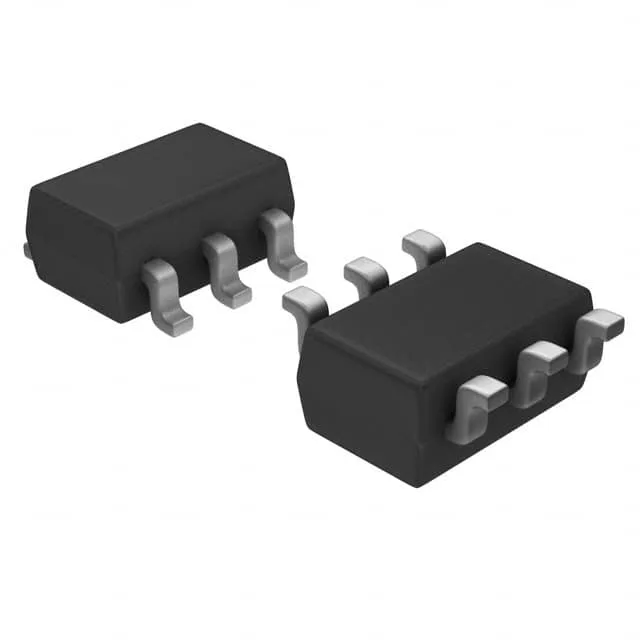
Single-bit D-type flip-flop with 175 MHz clock — the SOT-23-6 bus buffer workhorse
The SN74LVC1G374DBVR: The 175 MHz clock frequency and 4 ns propagation delay at 5 V, 50 pF make it suitable for high-speed bus isolation, register pipelines, and clock-domain crossing in mixed-voltage systems. The 32 mA source/sink output drive is generous for a single-gate device, enough to drive a small LED or a handful of CMOS inputs directly.
175 MHz clock — timing headroom for 100 MHz+ buses
The 175 MHz maximum clock frequency gives about 5.7 ns minimum clock period. With a 4 ns propagation delay, you have roughly 1.7 ns of timing margin before the next clock edge at 175 MHz — enough for short PCB traces but not for long backplane runs without retiming. At 100 MHz the margin widens to 6 ns, which covers most board-level routing. For comparison, the 74F374SCX-NS (a similar 8-bit octal flip-flop) tops out at 140 MHz, so this single-bit part actually clocks faster per element.
The 3 pF input capacitance keeps the load light on the driving stage. Quiescent current is 10 µA, negligible in most designs. The wide range is especially useful in battery-powered gear where the rail droops from 3.6 V to 1.8 V over discharge — the flip-flop keeps running.
Output drive: 32 mA source/sink — drives LEDs and high-fanout buses
The 32 mA output current capability is double what most single-gate logic provides. This lets the flip-flop directly drive an indicator LED (with a series resistor) or a clock distribution fan-out to four or five CMOS inputs without a separate buffer. The tri-state output lets you share a data bus with other devices — pull OE high to put the output in high-impedance.
Package and footprint: SOT-23-6
The SOT-23-6 package suits dense PCBs with standard reflow assembly. Power dissipation is low at 10 µA quiescent.
ROHS3 compliant covers the latest EU exemption updates, so no green-flag issues for global shipments. The base product number is 74LVC1G374; this DBVR suffix denotes the SOT-23-6 tape-and-reel variant.