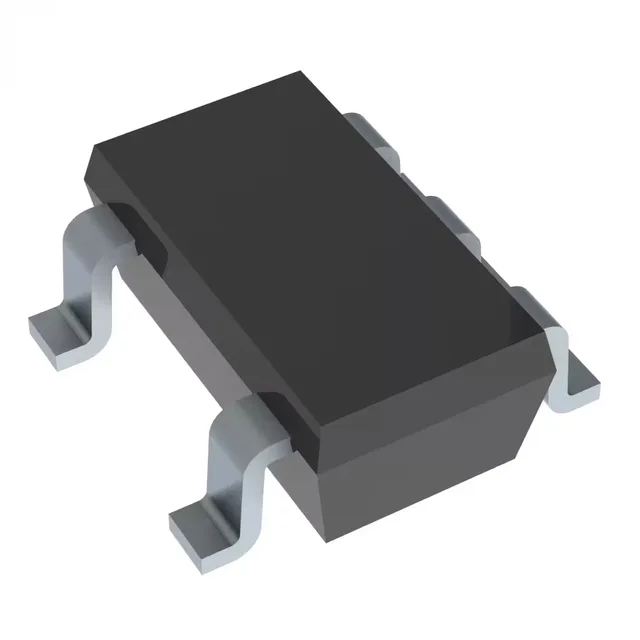
Single-gate Schmitt buffer for harsh environments
The SN74LVC1G17MDBVREP: The Schmitt-trigger input provides hysteresis that cleans up slow or noisy edges — useful when the buffer sits after a long PCB trace, a mechanical switch, or a sensor output that doesn't snap cleanly between logic levels. The push-pull output delivers a full 32 mA source and sink, enough to drive an indicator LED or a small relay coil without an extra transistor stage. Supply voltage spans 1.65V to 5.5V, so the part can serve as a level translator between a 1.8V MCU and a 3.3V or 5V peripheral, or simply buffer a signal within a single-voltage rail. The single-gate form factor keeps board area minimal — one buffer in a five-pin SOT-23 footprint, useful where a design needs just one extra clean-up gate without populating a multi-gate package.
The base product number 74LVC1G17 is a mature, widely second-sourced logic function, so if a secondary source is ever needed for dual-supply resilience, several semiconductor manufacturers offer pin-compatible equivalents in the same SOT-23-5 footprint.
This EP variant extends to the full military temperature envelope, which means it can sit in an engine bay, a satellite sun-facing panel, or a downhole tool that sees 125°C ambient — and still guarantee logic-level integrity. If your BOM doesn't need that temperature floor, a standard-grade sibling will cost less, but if the system qualification requires -55°C operation, this is the part that passes the thermal chamber. The 32 mA output current sets the maximum switching speed before edge rates degrade. For typical board-level buffering between two ICs, it is more than adequate.