Schmitt-trigger input: why a plain buffer won't do
The SN74LVC1G17DCKR is a single non-inverting buffer from TI's 74LVC family, but the Schmitt-trigger input on every pin is what separates it from a vanilla 1G07 or 1G34. That hysteresis — typically a few hundred millivolts — cleans up a noisy clock line, a slow-rising RC reset signal, or a sensor output that's been dragged through a long cable. Without it, a standard buffer would oscillate or pass glitches at the switching threshold. The part accepts a supply from 1.65V to 5.5V, so it bridges 1.8V, 2.5V, 3.3V, and 5V logic domains on the same board without a level translator.
32 mA output — what it can and can't drive
Each output sources or sinks 32 mA, which is enough to light a standard LED with a current-limiting resistor, drive the base of a small-signal transistor, or feed the input of a downstream gate with healthy margin. It is not a power buffer — don't plan on driving a relay coil or a 50-ohm backplane trace directly. The push-pull topology means no pull-up resistor needed; the output swings rail-to-rail within the load limit. At 32 mA the voltage drop across the output FETs will be a few hundred millivolts, so check the VOH/VOL curves in the datasheet if you need a tight logic-high at the far end of a 3.3V bus.
Temperature range and industrial fit
The 74LVC family is well-characterised across temperature; the propagation delay shifts predictably, and the Schmitt thresholds stay inside the datasheet limits. No derating needed at the high end for most designs, though the 32 mA drive current should be backed off above 105°C if the ambient is sustained.
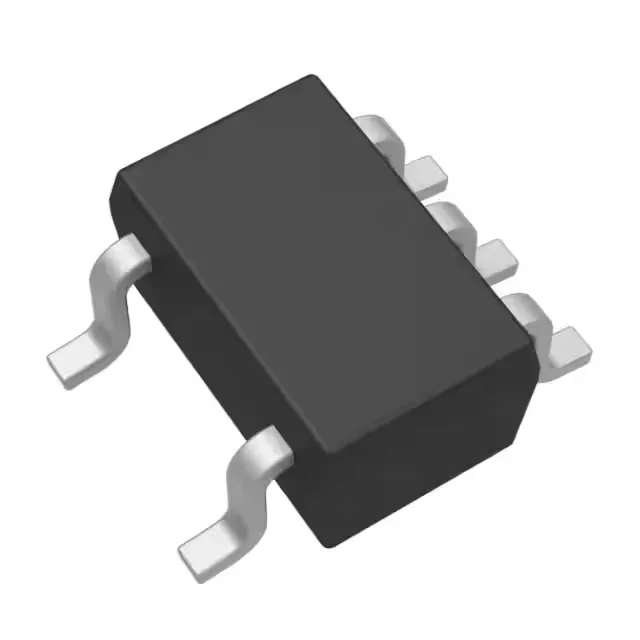
Supplied in the SC-70-5 (SOT-353) package, which is a 5-pin surface-mount case with 0.65 mm pitch. The footprint matches the industry-standard SC-70, so it is a drop-in for any board already laid out for that pattern. The Tape & Reel option (TR) is the usual procurement choice for automated assembly; Cut Tape (CT) is available for prototyping or low-volume builds. No thermal pad, no exposed paddle — the small body relies on the copper traces for heat spreading, which is fine for a single-gate buffer that dissipates well under 100 mW.
The 74LVC1G17 base number is a standard-catalogue logic part with broad distribution coverage. For dual-sourcing resilience, the same function is available from several other manufacturers in the SC-70-5 footprint — any pin-compatible single Schmitt-trigger buffer in the 1.65V to 5.5V range will match the board layout, though the hysteresis voltage and drive current should be verified against the original spec.