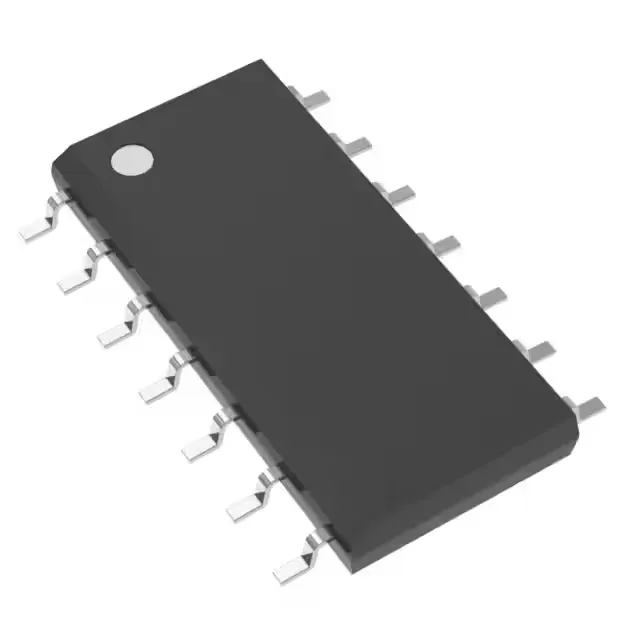
Schmitt trigger cleanup for noisy rails
The Texas Instruments SN74LVC14ADR is a hex inverter from the 74LVC family, but the Schmitt-trigger inputs are what separate it from a plain 74LVC04. Each of the six inverters has built-in hysteresis, so a slowly rising or noisy signal on the input doesn't cause multiple edges or oscillation at the output. That makes this part the go-to for debouncing switch inputs, squaring up RC-oscillator waveforms, and cleaning clock or reset lines that run across a board or through a cable.
6.2 ns — timing budget for 50 MHz+
At 3.3V and 50 pF load, the max propagation delay is 6.2 ns per the datasheet. That's fast enough to pass a 50 MHz clock through two or three inverters in series and still meet setup time on the receiving flip-flop. If the board runs at 100 MHz, budget one inverter per path or use a single-gate buffer instead. The 24 mA symmetric output drive (both source and sink) handles standard CMOS and LVTTL loads without an external buffer, and the 1 µA max quiescent current means the part doesn't add a measurable idle draw on a battery-powered assembly.
14-SOIC footprint, surface-mount assembly
No special reflow profile needed — standard lead-free solder profile works.