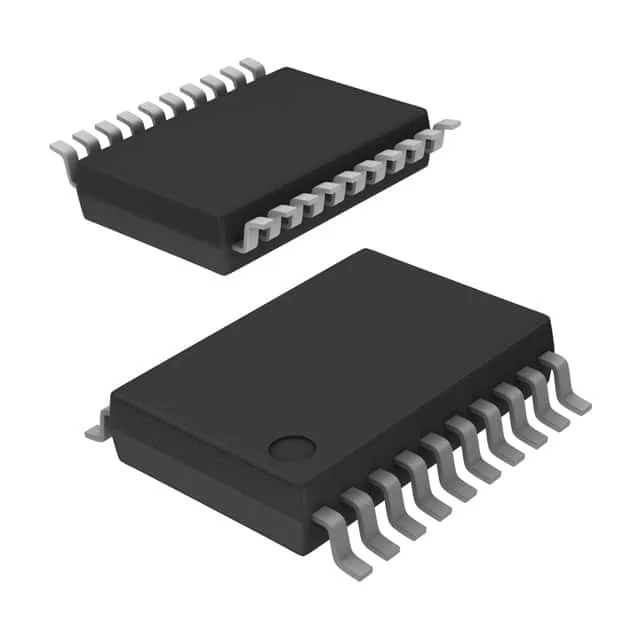
Two-element octal buffer for mixed-voltage bus isolation
The Texas Instruments SN74LV244ADBR is an octal buffer with non-inverting outputs and 3-state control, part of the 74LV low-voltage logic family. Each of the two elements handles four bits, giving you eight channels in a single 20-SSOP package. Output drive is 16 mA per pin, sufficient for driving a short ribbon cable or a bank of LED indicators through a resistor. The 3-state outputs let you float the bus when the buffer is deselected, which is the standard trick for shared data or address lines in a multi-peripheral system.
Supply voltage and logic compatibility — the 2V to 5.5V window
The 2V to 5.5V supply range is the headline spec that decides fit. At 3.3V the SN74LV244ADBR works directly with a 3.3V MCU or FPGA bank; at 5V it interfaces with legacy 5V TTL or CMOS logic. The thresholds track the supply proportionally, so a 3.3V-powered buffer sees a VIH around 2.0V and a VIL around 0.8V — compatible with both 3.3V CMOS outputs and 5V TTL outputs that swing above 2.4V. If your design lives at 1.8V, this is not the part; you would step up to the 74AUC or 74LVC1G series. For the 2.5V to 5.5V band, though, the 74LV family is a proven workhorse.
Temperature grade — industrial with a margin
The 125°C ceiling is the junction limit for most low-voltage CMOS processes; staying within that keeps propagation delay and output drive within datasheet limits.
Package and mounting — 20-SSOP surface-mount
Surface-mount only — no through-hole variant in this listing. The Tape & Reel option (TR) is the production-pick-and-place format; the Cut Tape (CT) suits prototype or low-volume builds.
Lifecycle — active and ROHS3 compliant
No lead (Pb) exemption applies, so it is fully compatible with lead-free reflow profiles.