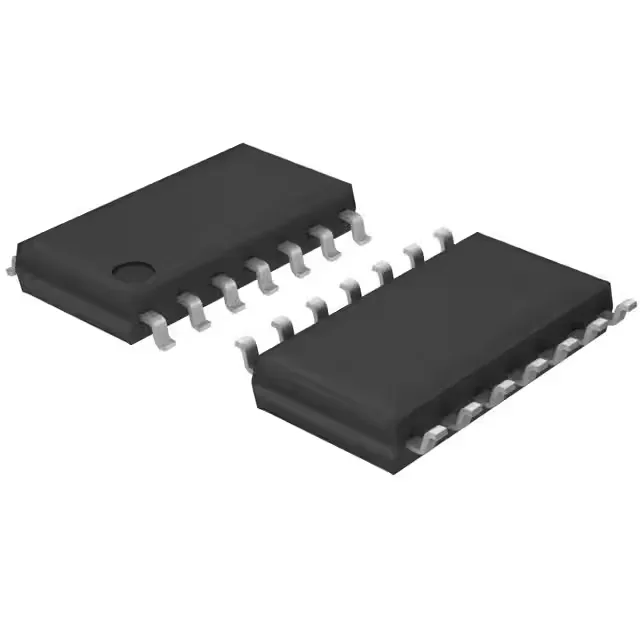
Texas Instruments SN74LV126ANS — Logic ICs

SN74LV126ANS 74LV Quad Buffer, Non-Inverting, 3-State

MPNSN74LV126ANS
End of Life

Texas Instruments 74LV series SN74LV126ANS, Buffer, Non-Inverting, 3-State, 4-Element, 1-Bit, 2V to 5.5V, 16mA, -40°C to 125°C, Surface Mount 14-SOIC, Tube.

$1.0Ref. price · indicative, final on quote
Packaging14-SOIC (0.209", 5.30mm Width)
RoHSROHS3 Compliant
Series74LV
Independent supplier — new & surplus stockAuthenticity-screened · ESD-safe packingListing updated Aug 2026

Specifications

SN74LV126ANS specifications
ParameterValue
Series74LV
Logic typeBuffer, Non-Inverting
Output type3-State
MountingSurface Mount
Supply voltage2V ~ 5.5V
Current - output high, low16mA, 16mA
Operating temperature-40°C ~ 125°C (TA)
PackageTube
Case14-SOIC (0.209\", 5.30mm Width)
Number of elements4
Number of bits per element1

Product details

Quad non-inverting buffer with 3-state outputs — 74LV family

It operates across a 2V to 5.5V supply range, making it usable on legacy 5V TTL buses and modern 3.3V or 2.5V logic rails alike. The 16mA symmetric source and sink drive is typical for this logic family — enough to drive a few CMOS inputs or a short PCB trace without needing a separate line driver. The 14-SOIC package (0.209", 5.30mm width) is a common footprint that routes easily on two-layer boards and reworks without hot-air stations.

Supply voltage flexibility — 2V to 5.5V

The 2V to 5.5V supply range is the headline selection parameter for this buffer. If your board has a 3.3V main rail and a 5V peripheral bus, this part bridges them without a level translator, as long as the input thresholds align. At 3.3V the 74LV family switches fast enough for most SPI and UART buses below 20 MHz; at 5V it meets TTL thresholds directly. The wide range also absorbs supply droop — a 3.3V rail that sags to 2.8V during a load transient still keeps the buffer operational.

3-state bus control

Each of the four buffers has its own output-enable pin, so you can gate individual signals onto a shared bus without external AND-OR logic. The 3-state output goes high-impedance when the enable is low, letting another driver take the line. This is the standard architecture for address/data bus buffers in microcontroller memory expansion or for multiplexing sensor outputs onto a single ADC input channel.

Frequently asked questions

What is the function of SN74LV126ANS?

It is a quad non-inverting buffer with 3-state outputs. Each of the four elements buffers one bit of data; the output can be set to high-impedance via the output-enable pin, allowing multiple drivers to share the same bus line.

Is SN74LV126ANS 3-state?

Yes, the outputs are 3-state — they can drive high, low, or go high-impedance when the output-enable pin is deasserted.

What is the equivalent of SN74LV126ANS?

A functional equivalent within the same 74LV family would be another quad non-inverting 3-state buffer in a 14-pin SOIC package, such as the SN74LV125A (quad bus buffer gate with 3-state outputs). The SN74LVTH16245ADGVR is a different class — a 16-bit transceiver with higher drive — and is not a pin-compatible substitute.