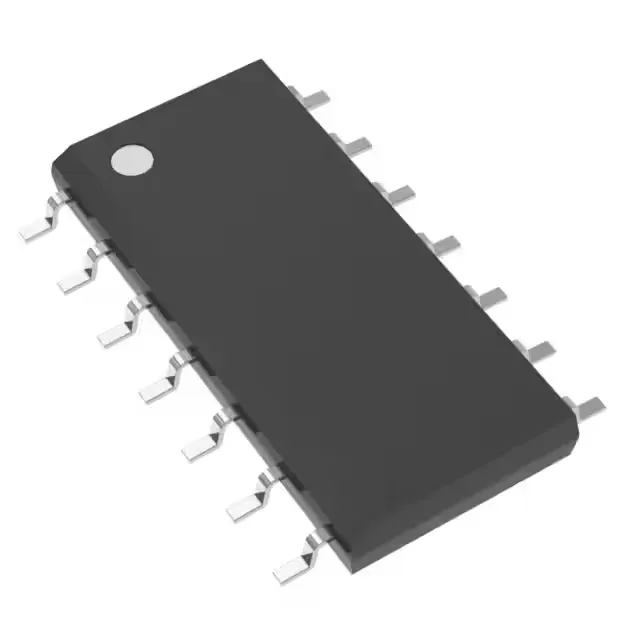
Texas Instruments SN74LV05ADR — Analog & Data Acquisition

SN74LV05ADR Hex Inverter, Open-Drain, 2V-5.5V, 14-SOIC

MPNSN74LV05ADR
End of Life

Texas Instruments 74LV series hex inverter, open-drain outputs, 6 circuits, 1 input per circuit, 2V to 5.5V supply, 7.5ns propagation delay at 5V/50pF, 12mA sink current, -40°C to 85°C, 14-SOIC package, Tape & Reel.

$0.57Ref. price · indicative, final on quote
Packaging14-SOIC (0.154", 3.90mm Width)
StockContact for availability
MOQ1 pcs
  • 100% new & originalTraceable channels only — no refurbs, no pulls, no remarked parts.
  • Date & lot codes on quoteStated per line before you commit; label photos on request.
  • MSL-compliant ESD packingMoisture-sealed bags with indicator cards; reels photo-verified.
  • PayPal buyer protectionPay by T/T, PayPal or Payoneer — card payments covered end to end.

Specifications

SN74LV05ADR Technical Specifications
ParameterValue
Series74LV
Logic typeInverter
Mounting typeSurface Mount
Voltage2V ~ 5.5V
Current - quiescent20 µA
Current - output high, low-, 12mA
Number of inputs1
Operating temperature-40°C ~ 85°C
PackageTape & Reel (TR); Cut Tape (CT)
FeaturesOpen Drain
Case14-SOIC (0.154\", 3.90mm Width)
Number of circuits6
Input logic level - low0.5V
Input logic level - high1.5V
Max propagation delay @ v, max CL7.5ns @ 5V, 50pF

Product details

Open-drain hex inverter for wired-OR and level translation

The Texas Instruments SN74LV05ADR is a hex inverter from the 74LV low-voltage logic family, with six independent inverter gates each featuring an open-drain output. The open-drain topology means the output can only sink current (12 mA per the datasheet) and cannot source it — the output transistor pulls low, and an external pull-up resistor is required to bring the output high. This makes the part fundamentally different from a standard push-pull inverter, which actively drives both high and low states. The supply range spans 2 V to 5.5 V, and the propagation delay is 7.5 ns at 5 V with a 50 pF load. Operating temperature covers -40°C to 85°C, suitable for industrial control, telecom infrastructure, and general-purpose board-level logic where the open-drain feature is needed.

What the open-drain output means for your design

The open-drain output is the key functional differentiator. Because the output is a floating high-impedance state when off, multiple SN74LV05ADR outputs can be connected to a single pull-up resistor to implement a wired-OR or wired-AND bus — common in interrupt lines, I²C-like signaling, or shared reset lines. The 12 mA sink capability is enough to drive a standard LED or a low-power relay coil with an appropriate series resistor, but the lack of source current means the part cannot directly drive CMOS logic inputs without an external pull-up.

Lifecycle and sourcing reality

The SN74LV05ADR is listed as Active in production with ROHS3 compliance.

Package and footprint

The part is supplied in a 14-SOIC package (0.154" body width, 3.90 mm width) with a surface-mount footprint. The supplier device package is 14-SOIC. The Tape & Reel option (TR) is standard for automated assembly; Cut Tape (CT) is also available for prototyping or low-volume builds.

Frequently asked questions

What is the functional difference between SN74LV05ADR and a standard inverter?

A standard inverter (e.g., SN74LV04) uses a push-pull output that actively drives both high and low states. The SN74LV05ADR uses an open-drain output that can only sink current (12 mA) and requires an external pull-up resistor to pull the output high. This allows wired-OR connections and level translation, but the output cannot source current.

Is SN74LV05ADR RoHS compliant?

Yes, the SN74LV05ADR is ROHS3 compliant per the manufacturer's listing.

Can SN74LV05ADR be used as a level translator?

Yes. Because the output is open-drain, connecting the external pull-up resistor to a different supply voltage than VCC shifts the output high level to that pull-up voltage. With VCC at 3.3 V and the pull-up at 5 V, the part translates 3.3 V logic inputs to 5 V logic outputs. The input thresholds (0.5 V low, 1.5 V high) are compatible with both 3.3 V and 5 V logic families.