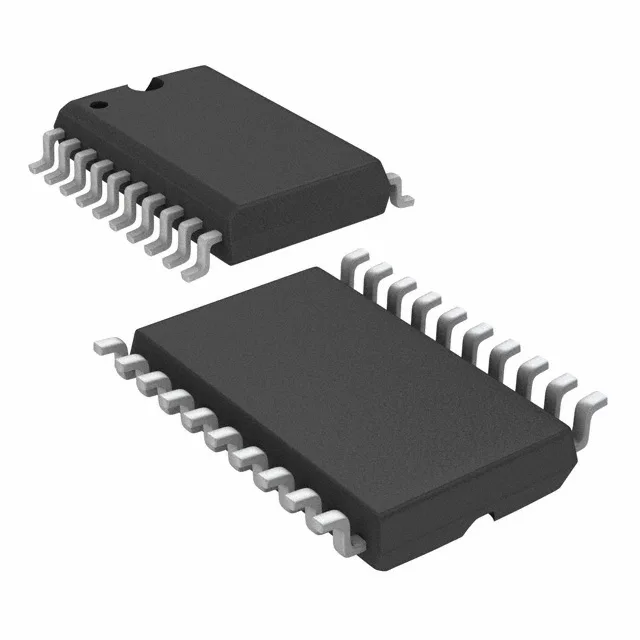
It compares two 8-bit words and asserts a single active-low output (A=B) when the words match. The output function is A=B, and the output is active low — meaning the pin goes low on a match, which is the convention for cascading in wide-word compare trees or driving an interrupt line. With a maximum propagation delay of 23 ns at 5 V into a 45 pF load, this part is fast enough for most 5 V backplane address decoding, memory-mapped I/O select generation, and bus-matching tasks running at clock rates up to about 20 MHz. The supply range is 4.85 V to 5.25 V, so it expects a regulated 5 V rail — not suitable for 3.3 V or mixed-voltage domains without level translation. The package is a 20-SOIC wide body (7.50 mm width), surface-mount only. No DIP option exists for this specific order code.
Output drive and fanout
The output can source 400 µA and sink 24 mA. That sink current is the important number: it can drive up to 10 standard 74LS loads (each rated at 360 µA input low current) plus a few more, so fanout is comfortable for typical bus interfaces. The source side is weak — 400 µA means it cannot drive a TTL input high directly without a pull-up resistor; in practice, the active-low output is usually wire-OR'd or pulled up externally.