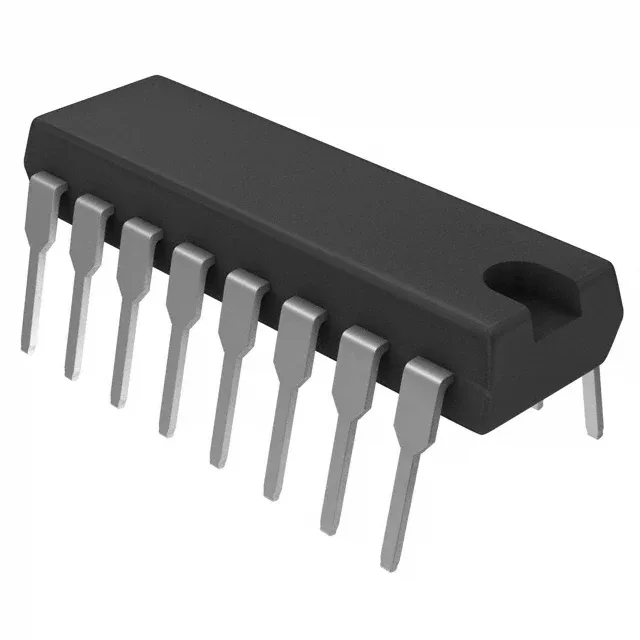
4 x 4 register file in a 16-pin DIP
The Texas Instruments SN74LS670N is a 4 x 4 register file from the 74LS Schottky family, organized as four independent 4-bit registers with a single 1:1 addressing scheme per circuit. It sits in a 16-pin DIP (0.300" body) with through-hole mounting — a footprint that has been standard in industrial control and legacy processor designs for decades. Output drive is specified at 2.6 mA source and 8 mA sink — enough to drive standard TTL inputs on a backplane but not intended for heavy capacitive or relay loads.
What the 4 x 4 architecture means on the bench
Four independent 4-bit registers with separate read and write addressing — the 1:1 circuit per register means each register has its own address decode, so simultaneous read and write operations to different registers are possible. The 16-pin DIP package dedicates four pins to address inputs (two for read, two for write), four for data I/O, plus control strobes and supply rails. The 2.6 mA / 8 mA output drive is typical for 74LS — expect a fan-out of about 10 standard LS loads per output. If driving a bus with higher capacitance, a 74LS244 buffer after the register file is a common layout fix.