Bus transceiver with open-collector outputs — LS TTL logic
The Texas Instruments SN74LS644-1N3 is an 8-bit bus transceiver from the 74LS family of low-power Schottky TTL logic. It features inverting logic and open-collector outputs, making it suited for bus-oriented systems where multiple drivers share a common line and active-low signalling is needed. The single-element device handles 8 bits per element, with a supply range of 4.75 V to 5.25 V — standard for 5 V TTL rails.
Output drive and bus termination
The open-collector outputs sink 24 mA when low but source only 100 µA when high. This asymmetry is the key design consideration: the high-level output relies entirely on an external pull-up resistor to VCC. For a 5 V rail, a 2.2 kΩ pull-up to 4.7 kΩ is typical, depending on fan-out and bus capacitance. The 24 mA sink capability drives standard TTL loads or LED indicators directly. The inverting logic means the bus signal is the complement of the data input — useful for active-low control buses or for matching polarity to legacy backplane protocols.
Through-hole DIP package — board integration
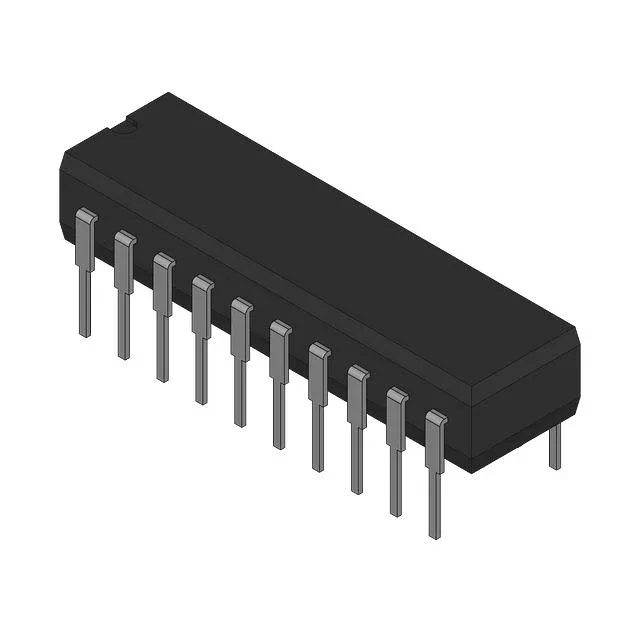
Housed in a 20-pin PDIP (0.300-inch body width, 7.62 mm pitch), the SN74LS644-1N3 is a through-hole device. This footprint is common on prototyping boards, breadboards, and legacy industrial PCBs that still use plated-through-hole assembly. The 0.300-inch width fits standard DIP sockets. For new designs, the through-hole package adds board area compared to surface-mount alternatives, but it simplifies manual assembly, rework, and field replacement in low-volume or repair contexts.