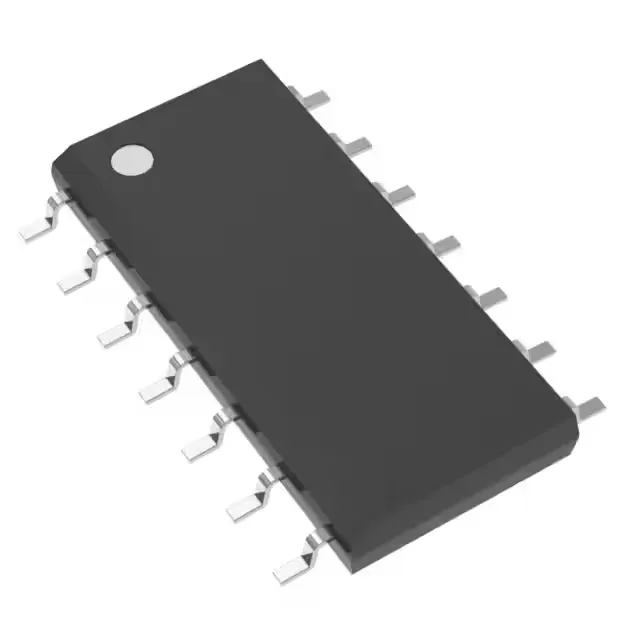
The SN74LS27D: Each of the three gates accepts three inputs and outputs a NOR result. The input thresholds are TTL-compatible: a low level below 0.8 V, a high level above 2 V. Output drive is 400 µA sourcing and 8 mA sinking — enough to feed one or two standard TTL loads but not a heavy bus or LED without a buffer. Propagation delay is 15 ns typical at 5 V with a 15 pF load — this sets the maximum toggle rate for the signal path. At 5 V the 74LS family's speed is roughly half that of the 74HC equivalent under the same load, but the LS input thresholds are a direct drop-in for legacy TTL designs that cannot tolerate the wider HC input swing.
Texas Instruments lists the SN74LS27D as Active with a ROHS3 compliance status. RoHS3 compliance (ROHS3 Compliant) means the part meets the EU's Restriction of Hazardous Substances directive including the four phthalates added in the 2015 amendment.
14-SOIC board-fit note
The supplier device package is also 14-SOIC — no second package variant exists under this order code. For a -40°C to +85°C requirement, the 74HC family (SN74HC27APWR or SN74HC27NS) is the closer fit, though it operates from a wider 2 V to 6 V supply and uses CMOS input thresholds rather than TTL.
Cross-reference check — 74LS vs 74HC
The SN74LS27D is pin-compatible with the 74HC27 variants (SN74HC27APWR, SN74HC27NS) — same 14-SOIC footprint, same triple 3-input NOR function. The key differences are supply voltage range (74LS: 4.75 V–5.25 V; 74HC: 2 V–6 V), input thresholds (TTL levels vs CMOS levels), and temperature grade (0°C–70°C vs -40°C–85°C). A board designed for the 74LS27 will accept the 74HC27 without rewiring, but the HC part's wider input swing may not recognise a marginal TTL-high signal as a logic '1'.