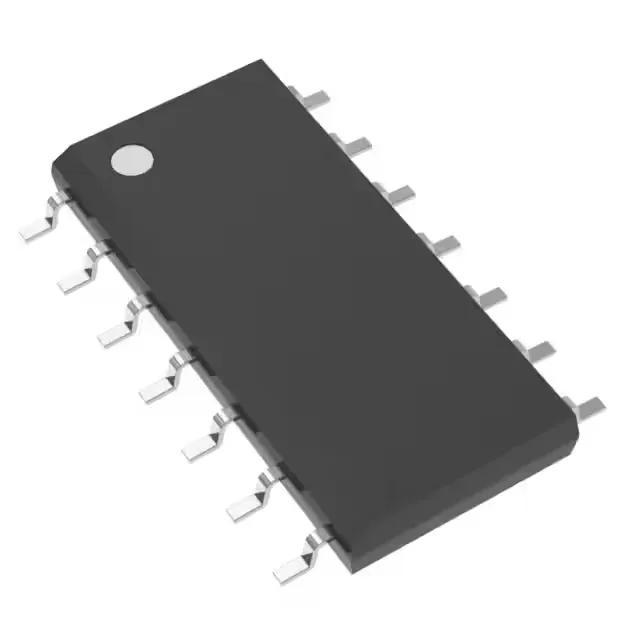
14-SOIC hex inverter with open-collector drive
The SN74LS06D is a hex inverter from the 74LS Schottky-clamped TTL family, with open-collector outputs that sink up to 40 mA per channel. Six independent inverters in a single 14-SOIC package, each with one input, give you six open-drain-style lines on a 3.90 mm-wide body — useful for driving relays, LEDs, or pulling bus lines low without external buffer stages.
What the 40 mA sink current means for your load
The open-collector output is rated for 40 mA sink current at the low level — this is the current the output transistor can pull down when the input is high. For a 5 V rail, a 120 Ω resistor to the output gives roughly 40 mA through the load; anything above that exceeds the sink rating and the output voltage rises above VOL, potentially losing the logic-low threshold at the receiver. The high-level output current is listed as '-' because an open collector cannot source current — it only pulls low. Propagation delay is 20 ns max at 5 V with a 15 pF load. That sets the maximum toggle rate around 25 MHz for a single inverter, though the open-collector rise time depends on the external pull-up resistor value and load capacitance — a 1 kΩ pull-up into 15 pF gives roughly a 15 ns RC time constant, so the actual usable frequency is lower than the bare propagation delay suggests.
It is RoHS3 compliant.